
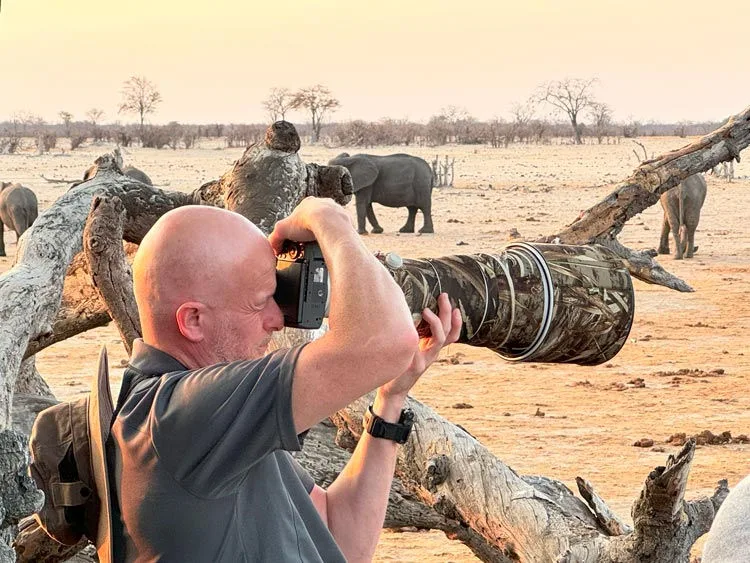
Smartphone Safari Photography Tips
How to bring home beautiful safari photos with just your phone: digiscoping through binoculars, wide landscapes, video, avoiding digital zoom, steadying your shot and realistic expectations.
You do not need a heavy camera bag to come home with photos you love. A modern smartphone, used cleverly, can capture sweeping landscapes, atmospheric camp life and even respectable wildlife shots, especially when you play to its strengths instead of fighting its limits. The honest catch is reach. A phone lens is wide by nature, so a lion two hundred metres away becomes a tiny speck, and pinch-to-zoom just enlarges a mushy digital crop. The trick is to stop trying to compete with a telephoto and instead lean into what phones do brilliantly: wide scenes, video, quick sharing and clever tricks like shooting through binoculars. Manage your expectations and the phone becomes a joy rather than a frustration. Think of it as the tool for the big picture and the story around the sighting, and let a guide's spotting scope or a fellow traveller's long lens handle the frame-filling portrait.
Key things to know
- Play to the phone's strength: wide landscapes, skies and camp life
- Digiscope through binoculars or a scope to reach distant animals
- Never use digital zoom; crop later instead for better quality
- Steady the phone on the vehicle, a beanbag or a small support
- Shoot video, which forgives distance and captures behaviour
- Lock focus and exposure by tapping and holding the subject
- Shoot at dawn and dusk for warm, flattering light
- Edit gently afterwards to lift contrast and colour
Work with the wide lens, not against it
Phones are landscape machines. The main lens is wide, sharp and superb for the grand scenes that define a safari: a sunrise bleeding across the plains, thorn trees against a bruised storm sky, or the whole herd strung along a ridge. These images often outlast the tight animal shots your neighbour struggled for with a big lens.
Lean into environmental storytelling. Include the vehicle, the dust, the acacia silhouette or the guide's hand pointing, and you capture the feeling of being there. A small animal within a beautiful landscape can be far more evocative than a cropped, grainy attempt at a distant portrait.
- Sunrises, sunsets and dramatic skies
- Wide herd scenes and sweeping plains
- Camp life, meals and the vehicle
- Silhouettes of trees and animals against the sky
- Details close to you: tracks, dung, feathers, textures
Digiscoping: borrowing reach from binoculars
The clever way to reach distant wildlife with a phone is digiscoping, holding the phone's lens up to the eyepiece of your binoculars or a spotting scope. With a steady hand and a little patience you can capture a surprisingly close view of a leopard in a tree or a distant elephant, effectively borrowing the optic's magnification.
It takes practice. Line up the phone lens centrally over the eyepiece, tap to focus on the animal, and brace both the binoculars and the phone against something solid. Inexpensive phone-to-scope adapters make alignment far easier and free up a hand. The results will never rival a professional telephoto, but they can be genuinely memorable.
Never pinch to zoom
The most common phone-safari mistake is stretching a distant animal with digital zoom. All this does is enlarge and soften a small portion of the sensor, giving you a mushy, noisy image. If the subject is too far for the main lens, either digiscope or accept the wider frame and crop later on a bigger screen.
A true optical telephoto lens on the phone, where fitted, is fine to use, but the huge multipliers shown on screen are mostly digital. As a rule, shoot at the phone's native focal lengths, keep the full resolution, and do your reframing afterwards in an editing app where you can judge quality properly.
- Digital zoom just crops and softens the image
- Use only true optical lenses, not the big on-screen multipliers
- Shoot wide at full resolution and crop later
- Consider digiscoping when you genuinely need reach
- Judge and reframe photos on a larger screen back at camp
Steady it and shoot video
Camera shake and a moving vehicle ruin more phone photos than anything else. Rest your elbows on the window ledge, brace the phone against the frame or a beanbag, and ask the driver to switch off the engine for still shots. A small flexible tripod or a clamp can be a game-changer for landscapes and time-lapses at camp.
Video is the phone's secret weapon on safari. It forgives distance far more than a still, captures behaviour, sound and movement, and is effortless to share. A steady thirty-second clip of elephants crossing or lions greeting often tells the story better than any photograph, and phones shoot beautiful, stabilised footage.
Light, timing and gentle editing
As with any camera, light makes the picture. Shoot in the soft golden hours of early morning and late afternoon when colours are warm and shadows are long, and avoid the harsh, flat glare of midday. Tap the screen to set focus, then slide the exposure control down a touch to protect bright skies from blowing out.
A little editing lifts a phone photo a long way. Straighten horizons, gently raise contrast and warmth, and crop for a stronger composition. Keep it subtle, avoiding oversaturated, over-sharpened looks. Shooting in your phone's raw or high-quality mode, where available, gives you far more room to recover shadows and highlights afterwards.
- Shoot in the golden hours for warm, flattering light
- Tap to focus, then drag exposure down to protect the sky
- Use raw or high-quality mode for editing headroom
- Straighten, crop and lift contrast gently
- Back up photos to the cloud or a laptop when you have signal
References & further reading
- Sinclair, A. R. E., et al. (Eds.) (2015). Serengeti IV. Chicago: University of Chicago Press.
- Estes, R. D. (2012). The Behavior Guide to African Mammals. Berkeley: University of California Press.
- Kingdon, J. (2015). The Kingdon Field Guide to African Mammals (2nd ed.). London: Bloomsbury.
- IUCN (2024). The IUCN Red List of Threatened Species, Version 2024-1. www.iucnredlist.org.
Do it with SafariLingo
Take SafariLingo on safari: 300+ species, real animal calls, offline maps and sighting logs — all in your language, wherever you roam.
Get the appFrequently asked questions
Can I get good wildlife photos with just a phone?
For distant animals a phone struggles, but for landscapes, camp life and closer subjects it does beautifully. To reach far wildlife, try digiscoping through binoculars or a scope. Manage expectations, play to the wide lens, and you will still come home with images you treasure.
How do I photograph animals that are far away?
Avoid digital zoom, which only softens the image. Instead, hold your phone lens to the eyepiece of your binoculars or a spotting scope, a technique called digiscoping, or shoot wide and crop later. Video also handles distance better than a still frame.
Why do my phone safari photos look blurry?
Usually it is camera shake, a moving vehicle, or digital zoom. Steady the phone on the window ledge or a beanbag, ask for the engine off, tap to lock focus, and never pinch to zoom. Good light at dawn and dusk also helps the phone keep shutter speeds high.
Should I shoot photos or video on my phone?
Do both, but lean on video for wildlife. It forgives distance, captures behaviour and sound, and is easy to share. Save photos for landscapes, skies and camp scenes where the phone's wide lens truly shines, and grab short, steady video clips of any animal action.
Related guides
 Wildlife
 How to Photograph Elephants and Big Mammals
A field guide to photographing elephants, rhinos and buffalo: conveying scale, capturing texture and family life, using backlight and dust, and keeping a respectful, safe distance.
 Wildlife
 Black-and-White Wildlife Photography on Safari
When and how to shoot wildlife in monochrome: using harsh light, texture and mood, dust and rain, elephants and rhinos, learning to think in tones, and balancing in-camera choices with post-processing.
 Wildlife
 How to Be a Responsible Safari Photographer
The ethics behind the lens on safari — distance, no baiting or calling, off-road rules, not blocking animals, respecting other guests and honesty in captions.