
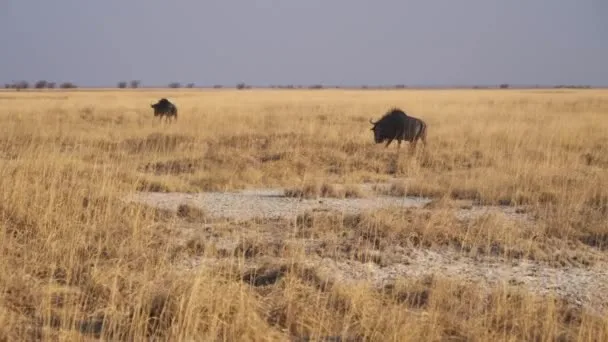
How Animals Survive the Dry Season
How Africa's wildlife endures the long dry months — water dependence, migration, shifting diets, fat reserves and the predator's edge at waterholes — and why the dry season is prime for game viewing.
For much of savanna Africa the year swings between two states: the green flush of the rains and the long, browning grind of the dry season. When the rain stops, the grass cures, seasonal pans shrink and the whole landscape tilts toward a single question — where is the water? The animals that thrive are those with a strategy, whether that is walking to it, digging for it, or getting by on the moisture locked in leaves. Understanding these strategies transforms a safari. The dry season is not a time of quiet hardship hidden from view; it is when survival plays out in the open. Herds concentrate along shrinking rivers and around waterholes, vegetation thins so animals are easier to see, and predators press their advantage where prey must come to drink. It is, for most classic parks, the prime game-viewing window. This guide walks through the toolkit wild animals use to get through the dry months — from the deep water dependence of buffalo and zebra to the desert tricks of oryx — and explains why, for the traveller, the toughest season for wildlife is often the most rewarding to witness.
Key things to know
- The dry season concentrates animals around permanent water, making them predictable and easy to find.
- Grazers depend heavily on drinking water; many browsers get much of their moisture from leaves.
- Migration and local movements are survival tools — herds walk to where water and forage remain.
- Elephants dig for water in dry riverbeds, opening access for many other species.
- Fat reserves built in the rains carry animals through lean months and shape breeding timing.
- Predators gain a decisive edge as prey funnels to shrinking waterholes and river crossings.
- Thinning vegetation and clumped herds make the dry season the classic prime game-viewing period.
- The hardest days come just before the rains break, when both grass and water are at their lowest.
Why the dry season is the great test
In most of East and Southern Africa the rains fall in one or two wet spells, then stop for months. Without new rain the grasses set seed and cure to pale straw, losing both moisture and much of their protein. Seasonal pans and side-channels evaporate, and rivers drop to a chain of pools. What looked like limitless space in the green season contracts to a few reliable water points, and the animals must organise their whole lives around them.
This is why body condition slides as the dry season deepens. Grazers work harder for poorer food, walk further to drink, and burn into the fat they laid down when the grass was green. The pinch is worst in the last weeks before the rains return, when the land is at its most exhausted. For a well-adapted animal it is a survivable squeeze; for the old, the very young and the weak, it is the season that tests them hardest.
Water dependence: who must drink and who need not
Species differ enormously in how tied they are to open water. Buffalo, zebra, waterbuck and warthog are water-dependent and rarely stray far from a river or pan in the dry months, drinking daily or near-daily. This dependence is exactly why they bunch up near permanent water and become so easy to watch. Elephants need large volumes too, but have a trick: they dig in dry sandy riverbeds to reach water below the surface, and those seeps are then used by many smaller animals.
At the other extreme sit the arid-country specialists. Gemsbok (oryx), springbok and eland can go long stretches with little or no drinking, extracting moisture from plants, feeding at night on leaves that have absorbed dew, and tolerating a higher body temperature to save water. Knowing which category an animal falls into tells you where to look for it as the land dries.
- Highly water-dependent: buffalo, zebra, waterbuck, warthog, hippo — stay near rivers and pans.
- Large but resourceful: elephants dig for water and open seeps for other species.
- Browsers with an edge: giraffe, kudu and eland draw moisture from leaves and pods.
- Desert specialists: gemsbok and springbok endure long dry spells with little drinking.
- The rule of thumb: find reliable water in the dry season and you find the game.
The great shuffle: migration and movement
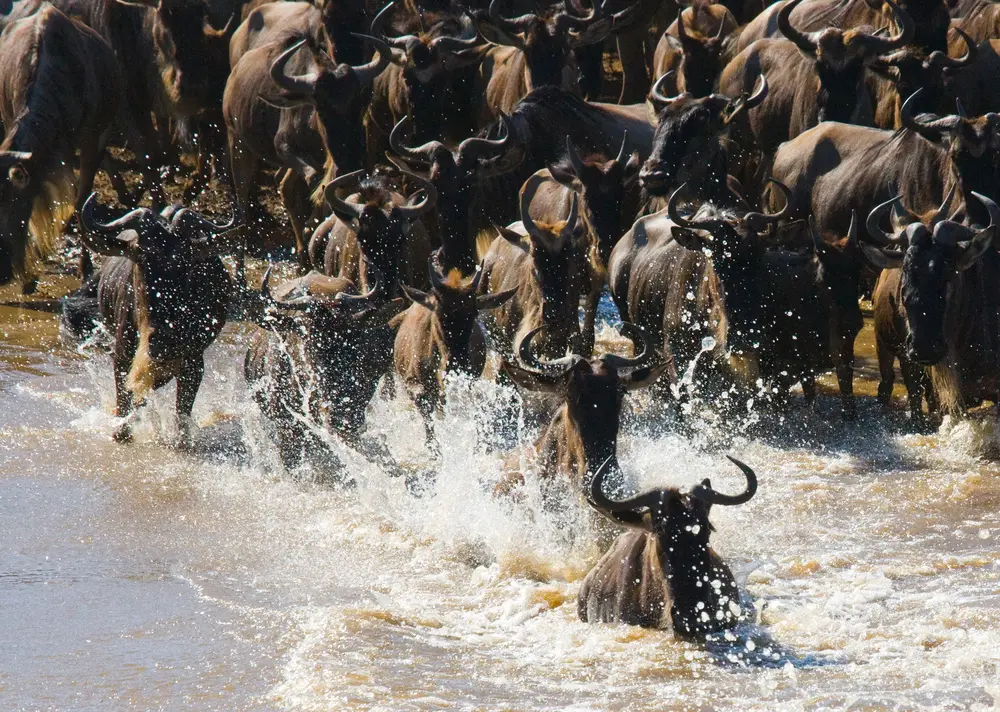
Movement is one of the oldest answers to a drying landscape. The best-known example is the Serengeti-Mara migration, where well over a million wildebeest with zebra and gazelle follow the rains and the flush of new grass in a vast annual loop, crossing the Mara River in the dry months of the northern Serengeti and Masai Mara. But movement operates at every scale, from continental journeys to a herd simply shifting a few kilometres to the last green valley.
In places like Botswana, elephants and buffalo move seasonally between the permanent water of the Okavango and Chobe systems and the drier interior, tracking the balance of water and food. For the traveller, knowing which way the animals are moving in a given month is the difference between an empty plain and a river bank packed with life. This is why timing and location matter so much when planning a trip.
Grazers, browsers and the shifting menu
As the season dries, animals adjust what and how they eat. Pure grazers such as wildebeest and zebra depend on grass and suffer most as it cures and thins; they seek out the last green regrowth in drainage lines and around water. Browsers such as giraffe, kudu and black rhino, which feed on leaves, shoots and pods from trees and shrubs, are buffered because woody plants stay green longer and hold moisture deeper into the dry season.
Many species are flexible. Elephants switch from grass toward bark, roots and browse; impala move fluidly between grazing and browsing depending on what is available. This dietary flexibility is a survival advantage, and it shapes where you find different animals: grazers pinned to the greenest remaining grass and water, browsers spread through the woodland where the leaves still hold.
- Grazers (wildebeest, zebra) chase the last green grass near water and drainage lines.
- Browsers (giraffe, kudu, rhino) rely on trees and shrubs that green longer.
- Elephants shift toward bark, roots and woody browse as grass fails.
- Mixed feeders like impala switch between grass and leaves as supply changes.
- Seed pods, especially from acacias, become vital high-energy food late in the dry season.
Fat reserves, condition and the timing of birth
Surviving the dry season is partly about what an animal did months earlier. In the productive green season, herbivores lay down fat and build condition; those reserves are then drawn down as forage quality falls. This is why breeding is so often timed to the rains: many species calve at or just before the wet season so mothers can feed on rich new grass while nursing, and young are strong before the next dry spell.
The wildebeest are the classic example, dropping the great majority of their calves in a short, synchronised window on the nutrient-rich southern Serengeti plains during the rains. Predators cannot possibly take them all in that flood of births, so more calves survive. The dry season, by contrast, is when the previous year's investment is spent, and the animals that budgeted well are the ones still standing when the first storms return.
The predator's season and why viewing is prime
For predators, the dry season is opportunity. As prey concentrates at shrinking waterholes and along the last flowing rivers, lions, leopards, cheetahs, wild dogs and hyenas find their quarry funnelled into predictable places. Waterholes become stages where thirst forces prey into the open and into range; some prides effectively hunt the approaches to water. Add weakened, thirsty animals at the end of the dry months and the balance tips further toward the hunters.
All of this is why the dry season is the classic time to book a safari. The grass is short and sparse, so animals are easier to spot; herds cluster at water where you can watch them for hours; and the drama of the hunt is more visible than at any other time. If your priority is big-game sightings and predator action, the toughest season for the animals is usually the best season for you.
- Prey concentrates at waterholes and rivers, so predators hunt predictable ground.
- Short, thin grass and bare trees make animals far easier to see and photograph.
- Weakened, thirsty prey late in the season shifts the odds toward predators.
- Waterholes and river crossings become reliable places for dramatic sightings.
- Fewer biting insects and little mud make dry-season game drives comfortable too.
References & further reading
- Sinclair, A. R. E., et al. (Eds.) (2015). Serengeti IV. Chicago: University of Chicago Press.
- Estes, R. D. (2012). The Behavior Guide to African Mammals. Berkeley: University of California Press.
- Kingdon, J. (2015). The Kingdon Field Guide to African Mammals (2nd ed.). London: Bloomsbury.
- IUCN (2024). The IUCN Red List of Threatened Species, Version 2024-1. www.iucnredlist.org.
Do it with SafariLingo
Take SafariLingo on safari: 300+ species, real animal calls, offline maps and sighting logs — all in your language, wherever you roam.
Get the appFrequently asked questions
Why is the dry season considered the best time for game viewing?
Because water becomes scarce, animals concentrate around rivers and waterholes where they are predictable and easy to find, while thinning grass and bare trees make them far easier to see. Predator action also peaks as prey is funnelled to water. It is the classic prime window in most East and Southern African parks.
Which animals can survive longest without drinking?
Arid-country specialists like gemsbok (oryx), springbok and eland can go long periods with little or no free water, drawing moisture from plants. Browsers such as giraffe and kudu are also buffered because leaves stay moist. Buffalo, zebra and waterbuck, by contrast, must drink daily or near-daily.
Do many animals starve during the dry season?
Healthy adults generally survive the squeeze by using fat reserves and shifting their diet, but the old, the very young and the sick are most at risk, especially in the last weeks before the rains. Natural die-offs are part of the cycle and feed scavengers and predators, which is why body condition is worth watching as a sign of the season's severity.
Are waterholes dangerous places for prey animals?
Yes. Predators know prey must drink, so approaches to water are prime ambush ground, and crocodiles add danger at rivers and pools. Prey animals manage the risk by drinking in nervous bursts, coming in numbers for extra eyes, and often watering in the safer light of early morning.
When exactly is the dry season in Africa?
It varies by region, but in much of East Africa the main dry months run roughly June to October, and in Southern Africa broadly May to October, with the toughest conditions just before the rains break. Check the specific park and year, as timing shifts, but those windows are the usual prime safari season.
Related guides
 Wildlife
 Waterhole Watching: A Complete Guide
How to watch an African waterhole productively — timing, the daily procession of animals, predator tension, hides and etiquette, plus iconic waterholes to try.
 Wildlife
 How to Spot Camouflaged Animals
Train your safari eye: scanning technique, looking for shapes, movement and parts rather than whole animals, and letting your guide teach you a search image.
 Wildlife
 Understanding the Savanna Food Chain
How the African savanna fits together — from grasses and acacias to grazers, browsers, predators, scavengers and decomposers — plus the keystone species and cascades that make the whole ecosystem work.