
Guided Walking Safari: What to Expect and Practical Tips
A field guide to your first walking safari — group size, safety protocols, footwear, fitness, wind and the small things that make walking the most intimate way to experience Africa.
After a week of game drives, stepping down from the vehicle for the first time is a small revolution. On foot, the bush shifts scale: dung beetles roll through your boot prints, a francolin explodes underfoot, the wind you never noticed suddenly matters, and the elephant that looked distant from the Land Cruiser now feels enormous. A guided walking safari is not a downgrade from driving — it is a different way of seeing, slower and much more textured. This piece explains what a walk with a professional guide is actually like: how the group is arranged, what an armed guide does and does not do, what you should wear on your feet, and how to behave if things get interesting. Walking safaris are safer than headlines suggest, provided you follow a few unbending rules.
Key things to know
- Small groups (typically 4–8 guests) led by a fully qualified armed guide
- Single file, silence and hand signals — talk at breaks, not on the move
- Wind awareness is the whole game — approach from downwind
- Ankle-supporting closed boots, muted colours, sunhat, water
- Never run, no matter what — running triggers a chase response
- Walks last 2–4 hours, usually early morning; some camps offer longer
- Focus on tracks, dung, birds and small things rather than big cats
- Fitness required is modest but heat and terrain add up
How a walking safari is structured
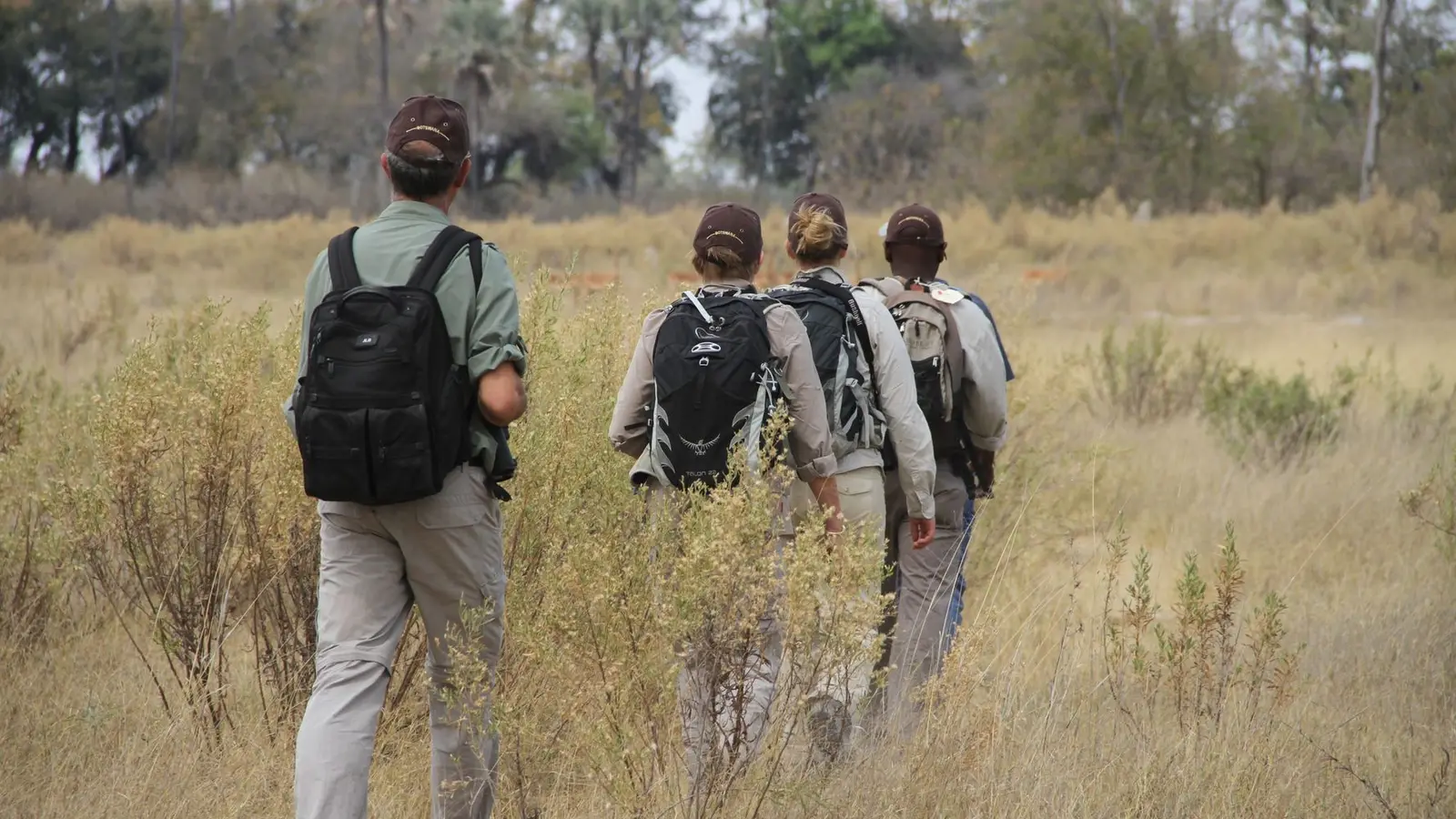
A typical walk has a professional armed guide at the front, sometimes a tracker beside him reading the ground, guests in single file behind, and a back-up guide at the tail. Groups are kept small — usually four to six, at most eight — because larger parties make noise, are hard to control in an encounter, and cover ground poorly. Before you set off, the guide will give a briefing on hand signals, single-file discipline, and what to do if you meet elephants, buffalo or lion. Ask questions. Repeat back what you have understood.
The walk itself is not a route march. Expect long pauses over a dung pile, on a game path or under a tree while your guide reads what has passed through. The point is interpretation of a landscape, not distance covered.
- Lead guide (armed, licensed)
- Optional tracker
- Guests in single file
- Back-up guide behind
- Radio contact with camp
Safety: rules that never bend
Follow the guide. Stay in single file. Do not step off the line to get a better photo. Do not overtake. If the guide raises a hand, freeze — that is the signal for danger, and every fibre of you must obey it. If he signals to back away, walk backwards slowly, keeping the animal in sight; never turn and run. Running triggers predator instinct in lions and leopards and can turn a stand-off into a pursuit.
A professional guide carries a heavy-calibre rifle for the small percentage of encounters that could turn dangerous, but the rifle is a last resort — the guide's real weapon is the wind, cover, distance and reading of animal behaviour. Trust that decades of training and experience have preceded your walk.
Wind, tracks and small worlds
Wind decides everything on a walk. Approaching an elephant into the wind is safe and often thrilling; downwind of the same animal is dangerous. Your guide will check the wind constantly, sometimes with a small talcum-powder puff, adjusting the whole route to keep you hidden and downwind of large animals.
On foot you notice what a vehicle drowns out: the perfume of wild jasmine, cicadas peaking as heat rises, the tap-tap of a woodhoopoe, tortoise tracks in the dust, a leopard scrape under a marula tree. Great walking guides use these small things to teach you how the whole system connects.
- Wind checked minute by minute
- Dung freshness (temperature, insect activity)
- Tracks by species, age and direction
- Alarm calls (impala, baboon)
- Bird behaviour and calls
What to wear and carry
Ankle-supporting closed boots or sturdy trail shoes — sandals are a bad idea because of thorns, ants and stones. Wear muted greens, browns or khaki; never bright colours, white or, in tsetse-fly areas, dark blue or black. A hat with a brim and a light long-sleeve shirt beat sunscreen alone in heat. Carry a small daypack with 1.5 litres of water, sunscreen, buff, a lightweight camera and any personal medication.
Gaiters help in long grass, especially in Zambia. In areas with dew or wet grass, quick-dry trousers are better than jeans. Binoculars are essential — leave the big zoom lens at camp if it slows you down.
- Ankle boots or trail shoes
- Muted greens/browns/khaki
- Sun hat with brim
- Long-sleeve shirt, quick-dry trousers
- Daypack, water, sunscreen
- Compact binoculars
Who a walking safari suits
Fitness required is modest — most walks cover 4 to 8 km at slow pace over gentle terrain, though heat, sand and the surprise of freezing to watch a rhino for twenty minutes make it more tiring than the distance suggests. If you can hike 6 km on a warm summer day at home, you are ready. Many camps set a minimum age of 12, some 16.
It suits birders, botanists, tracker-curious travellers, and anyone who wants to slow the safari down. It is not the best format if seeing many big cats is your priority — for that, drives are more efficient. Ideally combine both: two or three days of walking inside a longer driving itinerary.
Where to go for the best walking
Zambia's South Luangwa is the birthplace of the modern walking safari, thanks to Norman Carr's pioneering work in the 1950s and 60s, and still has some of the most experienced walking guides in Africa. Zimbabwe's Mana Pools is legendary for elephants and offer world-class walking led by professional-guide-licensed operators. Botswana's Okavango offers walks between water-based activities. Namibia has walking with San trackers in the Kalahari; East Africa has walking in Kenya's conservancies (Loisaba, Laikipia) and Tanzania's Wayo/Serengeti wilderness zones.
Each region has its rhythm. South Luangwa hands you fieldcraft and small mammals; Mana Pools puts you in among elephants; Kalahari makes you a student of tracking. All are safe with the right guide.
- South Luangwa, Zambia — the origin
- Mana Pools, Zimbabwe — walking with elephants
- Kalahari — San trackers
- Laikipia and Loisaba, Kenya
- Serengeti-adjacent wilderness zones, Tanzania
References & further reading
- Sinclair, A. R. E., et al. (Eds.) (2015). Serengeti IV. Chicago: University of Chicago Press.
- Estes, R. D. (2012). The Behavior Guide to African Mammals. Berkeley: University of California Press.
- Kingdon, J. (2015). The Kingdon Field Guide to African Mammals (2nd ed.). London: Bloomsbury.
- IUCN (2024). The IUCN Red List of Threatened Species, Version 2024-1. www.iucnredlist.org.
Do it with SafariLingo
Take SafariLingo on safari: 300+ species, real animal calls, offline maps and sighting logs — all in your language, wherever you roam.
Get the appFrequently asked questions
Is a walking safari dangerous?
Statistically no, when led by a fully qualified professional guide. Serious incidents are rare and almost always trace back to guests breaking the single-file, wind or distance rules. The core rule — do exactly what your guide says — makes it very safe.
What happens if we encounter a lion or elephant on foot?
The guide freezes the group, reads the animal, and moves you back at an angle that respects the wind and the animal's escape route. Almost every encounter ends peacefully. Lions rarely see humans as prey when we stand our ground; elephants respond to distance and calm.
How fit do I need to be?
Moderately. If you can walk 6–8 km on undulating trails in warm weather, you are fine. It is a slow walk with many stops. Heat is the main challenge — start early, hydrate, wear a hat.
Can children join a walking safari?
Most operators set a minimum age of 12 or 16 because children have less impulse control in an encounter. Some camps offer 'walks around camp' or bush skills sessions for younger children. Check with your operator.
Do the guides really carry rifles?
Yes, in most walking countries a heavy-calibre rifle is legally required and the guide is examined on it. It is a last resort tool. The real safety comes from the guide's ability to avoid situations that require it in the first place.
Related guides
 National Parks
 Canoe and Mokoro Safari: The Water-Level Wilderness
What a canoe or mokoro safari really involves — Okavango's dugout channels and the Lower Zambezi's canoe trails, safety around hippos and crocs, and why water-level travel changes everything.
 National Parks
 Boat-Based Safaris Explained
How boat safaris in Africa really work — the Chobe, Zambezi and Kazinga Channel — approach angles, birding advantages, photography and why the water is often the best sundowner in Africa.
 National Parks
 Horseback Safari Explained
How horseback safaris work in Africa — riding among plains game in the Okavango, Laikipia and Kenya's highlands — required experience, safety and the unique perspective of the saddle.