
Boat-Based Safaris Explained
How boat safaris in Africa really work — the Chobe, Zambezi and Kazinga Channel — approach angles, birding advantages, photography and why the water is often the best sundowner in Africa.
A boat safari is not a compromise for people who cannot handle 4x4s; it is one of the most productive game-viewing formats in Africa. On the Chobe or Zambezi you cover ground silently, approach from an angle animals rarely worry about, and see species — elephants swimming, giant kingfishers hovering, hippos entirely underwater — that a vehicle can never show you. On Uganda's Kazinga Channel or Rwanda's Lake Kivu the payoff is different — thick concentrations of hippos, waterbirds and pods of Nile crocodiles. This guide covers the main boat-safari waterways, what a typical trip is like, the photography angles they unlock, safety around large water animals, and the small equipment decisions that make the difference between a fun outing and one of the best afternoons of your holiday.
Key things to know
- Boats let you approach wildlife from an angle animals do not fear
- Chobe, Zambezi and Kazinga are the classic boat-safari corridors
- Best in the dry season when animals concentrate at the water
- Enormous birding upside — waders, kingfishers, fish eagles
- Low, eye-level photography angles impossible from a vehicle
- Sunsets on the water are the region's classic sundowner ritual
- Safety is straightforward — professional captains manage hippos
- Combines beautifully with drives at the same camp
Where Africa's best boat safaris happen
The undisputed leaders are the Chobe River (Botswana/Namibia) and the Zambezi in its middle and lower reaches. Chobe offers legendary elephant densities at the water's edge in the dry season (June–October), when herds from the woodlands trek to drink and swim. The Zambezi around Lower Zambezi National Park (Zambia) and Mana Pools (Zimbabwe) has more open banks, hippos in sculpted pools and thrilling stretches of gorge. Uganda's Kazinga Channel between Lake Edward and Lake George is a two-hour boat classic with buffalo, elephant, hippos in the hundreds and world-class waterbirds.
Smaller boat-safari options are excellent in the right hands: Selinda Spillway, Kwando/Linyanti, Kariba, Volta Bay in Ghana, and Lake Kivu on Rwanda's western edge. Most safari camps on major rivers offer a boat cruise as one of their standard activities.
- Chobe River — elephants, sunset, birds
- Lower Zambezi — hippos, sculpted pools
- Mana Pools — walking + canoe + boat
- Kazinga Channel, Uganda — buffalo, hippos, birds
- Kariba, Rwanda's lakes, Selinda backwaters
What a typical boat outing is like
Most camp boats are open aluminium pontoons or small covered launches carrying 6–12 guests, with a knowledgeable driver-guide who reads the water and the wind. Morning outings often go up-current, coasting back with the flow; afternoon cruises deliberately time golden hour and finish with a sundowner drink watching hippos yawn. Longer specialist boats — for photography — can be private and low, sit near water level, and stop for extended time.
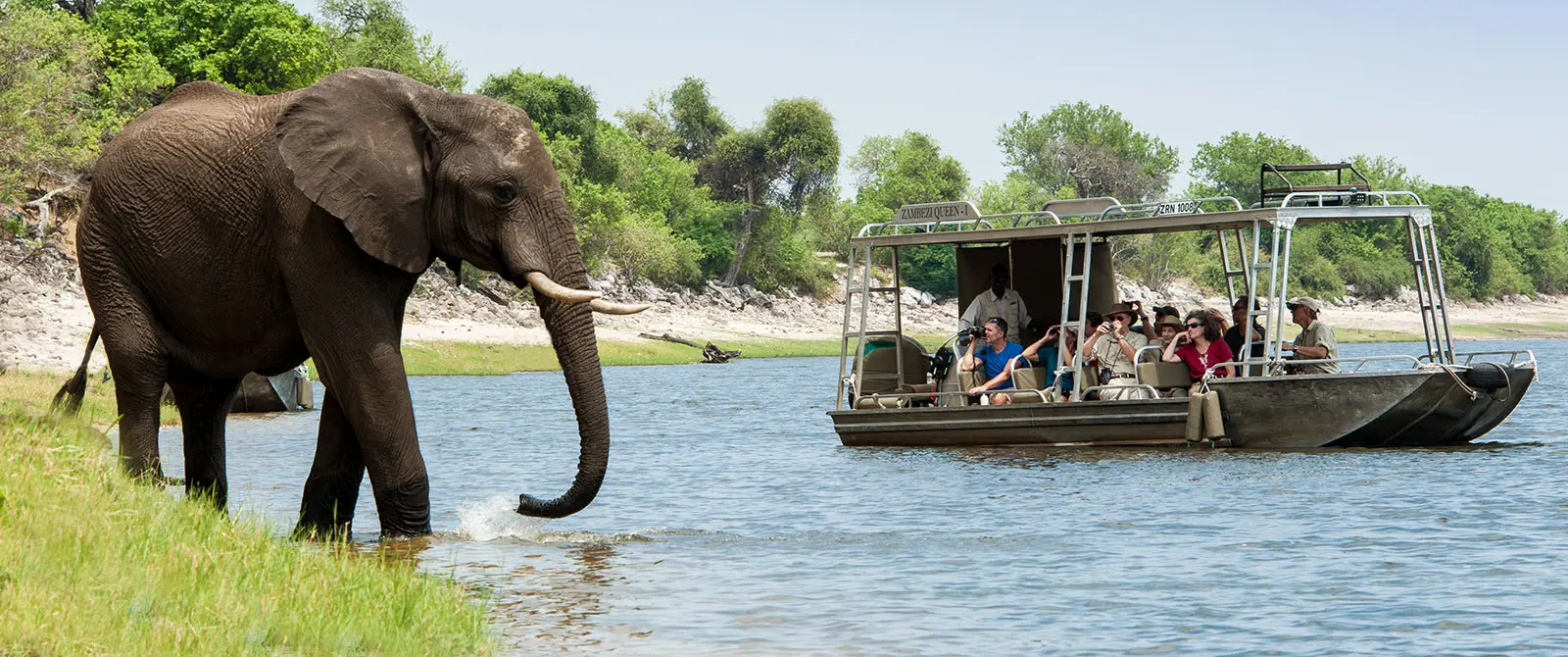
The rhythm is different to a drive. You slide up to a scene, cut the engine, drift, and watch. Elephants that would move away from a Land Cruiser will stay to drink; puku and impala barely lift their heads; the whole tempo of a river bank plays out in front of you.
Approach angle and why boats are so effective
African wildlife is habituated to human threat from the land side but far less so from water. This is why elephants that see a vehicle at 80 metres will drink for an hour with a boat quietly at 25. Predators use the water sparingly, and prey species know it. On the Chobe you can watch elephant families cross entire channels, trunks lifted like snorkels, calves in the middle of the file — a spectacle that only the boat delivers.
Boats also deliver small mammals, reptiles and birds that vehicles miss: monitor lizards on banks, water mongoose, otters, waders working the mud, malachite and giant kingfishers, jacanas walking on lilies. This dimension alone makes at least one boat outing worth building into any river-adjacent itinerary.
Photography from the water
For photography the boat is transformative. You are low, often on eye level with the subject, and you can inch closer without engine noise. The catch is stability: shooting a fish eagle taking a fish means bumping the shutter to 1/2000 or faster and using a monopod-free technique — elbows tucked, hands steady, shoulders relaxed. Beanbags do not work on a moving hull; bring a rolled-up soft cushion instead.
Works well: wide angles of elephants against sky, long lenses on fish eagles and kingfishers, close-focus on jacanas, silhouettes at sundown. Watch for spray on your front element; keep a microfibre cloth ready. Waterproof housings are overkill for calm rivers; a rain cover is enough.
- Fast shutter for birds — 1/1600–1/2500
- Aperture priority + auto-ISO works well
- No beanbag; use soft rolled cushion
- Wide + tele body pair is best
- Sunset silhouettes are the region's signature
Safety, hippos and etiquette
Boat safaris are safe when the captain knows the water. Hippos are the main consideration: territorial pods surface unpredictably; captains cut wide and never idle above a submerged animal. If a hippo yawns big or opens its mouth vertically, respect it and give distance. Crocodiles are almost never a boat risk. Wear a life jacket where required by the operator and always if you cannot swim.
Etiquette matters. Boat traffic on the Chobe is heavy at peak times, and a good captain will queue for a scene, not muscle in. Avoid loud voices, do not lean out to point, and be careful with drinks and phones near the gunwale.
Timing and how to combine
Boat safaris are best in the dry season — June to October across most of the classic corridors — when animals concentrate at the water and low water levels expose beaches and mudflats. Green season (November–March) is quieter, greener and better for birding as migrants arrive; game viewing is still solid but more spread out. Sundowner cruises are magic year-round.
Almost every itinerary in northern Botswana, the Zambezi corridor, and Queen Elizabeth NP in Uganda includes at least one boat outing. The most rewarding trips build several — a Chobe boat morning, a Zambezi sundowner, a Kazinga cruise on the way to Bwindi. Boat safaris are the perfect afternoon complement to a morning game drive.
- Dry season for game
- Green season for birds
- Sundowners year-round
- Morning up-current, evening drift with light
- Alternate drives and boats each day
References & further reading
- Sinclair, A. R. E., et al. (Eds.) (2015). Serengeti IV. Chicago: University of Chicago Press.
- Estes, R. D. (2012). The Behavior Guide to African Mammals. Berkeley: University of California Press.
- Kingdon, J. (2015). The Kingdon Field Guide to African Mammals (2nd ed.). London: Bloomsbury.
- IUCN (2024). The IUCN Red List of Threatened Species, Version 2024-1. www.iucnredlist.org.
Do it with SafariLingo
Take SafariLingo on safari: 300+ species, real animal calls, offline maps and sighting logs — all in your language, wherever you roam.
Get the appFrequently asked questions
Are boat safaris safer than game drives?
Both are very safe under professional captains and guides. Boat risk is essentially hippos, which experienced captains manage with distance. The main practical safety point is life jackets and not standing up.
Do I need a big camera?
No. A phone works well on the Chobe at sundown, and a compact zoom camera catches most subjects. If you have a DSLR or mirrorless, a 100–400 or 200–600 is ideal from water level.
How long is a typical boat cruise?
Two to three hours, either morning or late afternoon into sundown. Some camps offer full-day photography boats or breakfast/lunch cruises.
Can children go?
Most operators allow children from about six on standard boats with life jackets and a briefing. Ask your camp — some private-boat charters have flexible minimum ages.
Which country is best for a boat safari?
Botswana's Chobe for elephant density and sunset scenes; Zambia's Lower Zambezi and Zimbabwe's Mana Pools for wilder, quieter waters; Uganda's Kazinga for hippos and birds. Combining a river safari with a savanna park is the ideal.
Related guides
 National Parks
 Horseback Safari Explained
How horseback safaris work in Africa — riding among plains game in the Okavango, Laikipia and Kenya's highlands — required experience, safety and the unique perspective of the saddle.
 National Parks
 Gorilla Trekking: What to Expect on the Day
A day in the mountain forest with a habituated gorilla family — permits, altitude, the seven-metre rule, the one-hour visit, porters, health rules and why it is one of Africa's most humbling experiences.
 National Parks
 Chimpanzee Tracking Explained
How chimpanzee tracking works — Kibale, Nyungwe, Mahale, Gombe — how it differs from gorillas, permit costs, forest sound and the strange intimacy of being nearer to our closest relative.