
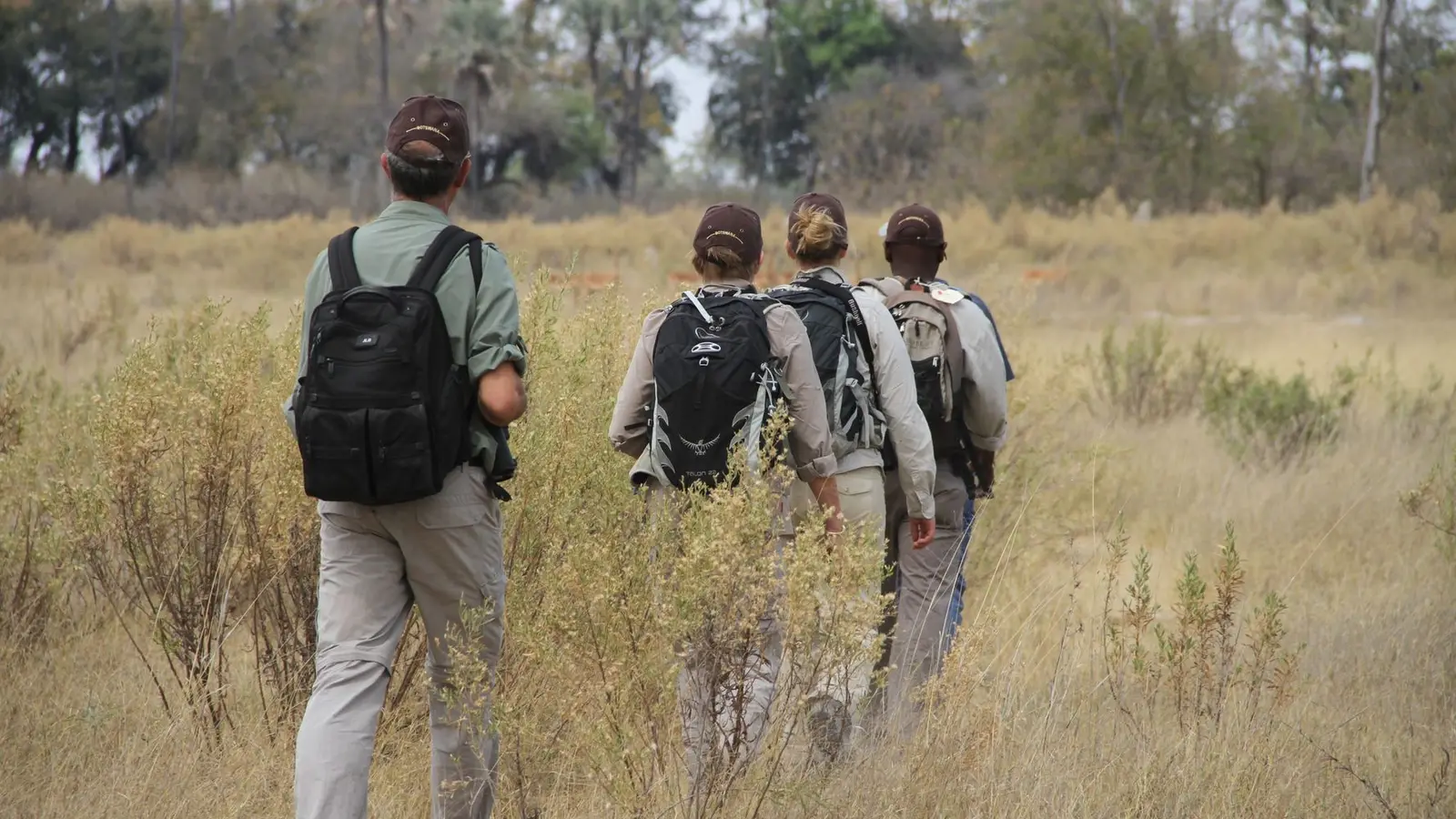
Canoe and Mokoro Safari: The Water-Level Wilderness
What a canoe or mokoro safari really involves — Okavango's dugout channels and the Lower Zambezi's canoe trails, safety around hippos and crocs, and why water-level travel changes everything.
Getting down to water level in Africa is a quieter, more textured way to see wildlife than any drive. In a mokoro — the traditional dugout used across the Okavango — a poler stands at the stern and pushes you silently through papyrus and lily channels. On the Lower Zambezi, longer Canadian-style canoes glide with the current beneath fig-lined banks. In both cases the vehicle is gone, the engine noise is gone, and you approach animals at their level. Elephants drink two boat-lengths away, sitatunga freeze in the reeds, painted reed frogs cling to grass at eye height, and a kingfisher can hover close enough that you hear its wings. Canoe and mokoro safaris are not for every itinerary and not for the risk-averse. They involve real animals — hippos are the leading cause of dangerous incidents on African water — and they need a genuinely experienced guide. But when the fit is right, water-level travel is often the single most memorable part of a longer trip. This guide covers what to expect, the safety logic, and where to do it best.
Key things to know
- Mokoro is a poled dugout used mostly in the Okavango Delta
- Canoe safaris on the Lower Zambezi use larger open canoes with paddles
- Both need an experienced guide who knows the resident hippos
- Hippos, not crocodiles, are the main safety consideration
- Best in the flood or dry season depending on region — check locally
- Silent approach delivers unusual birding, small mammals and reptiles
- Not typical big-cat viewing — a different set of species
- Combines well with land-based drives at the same camp
Mokoro on the Okavango: the classic
A mokoro is a slim wooden or fibreglass dugout, poled by a standing guide who reads the channel by feel as much as sight. Traditionally, mokoros are made from a single trunk of jackalberry or sausage tree; fibreglass has become standard for conservation reasons. You sit low, feet forward, water inches from the gunwale, gliding through papyrus corridors and clear lily-choked lagoons.
The Okavango's mokoro season is loosely tied to the annual flood — the pulse that arrives from Angola between roughly May and August depending on the year. High water opens more channels; low water forces polers into the main lagoons. Camps in the permanent delta (Xigera, Vumbura, Jao) run mokoros year-round in wet years; seasonal camps in the fringes are more flood-dependent.
- Two guests per mokoro plus one poler
- Sit low, no standing while moving
- Personal bag between your feet, drybag if raining
- Silence — animals allow closer approach
- Camera on a strap, not around the neck
Canoe safaris on the Lower Zambezi
The Lower Zambezi National Park (Zambia) and Mana Pools (Zimbabwe) offer the archetypal African canoe experience: a Canadian-style open canoe with paddles, a guide in the stern (or a lead canoe steering the group), and long, slow days drifting between islands, sandbanks and pods of hippos. You will see elephants swimming, crocodiles basking, waterbucks stepping in the shallows, skimmers slicing the surface, and enormous ancient African fish eagles calling.
Canoe trips can be day paddles from a lodge or multi-day expeditions with mobile camps set up ashore each night. Both formats are excellent. Multi-day trips are physically manageable — you drift with a strong current for much of the day — but require adjustment to camp life and stronger nerves around hippos.
Hippos, crocs and staying safe
Hippos are the animal to respect on African water. They are territorial, unpredictable when their route to deep water is blocked, and cows with calves will attack anything they perceive as threat. Your guide's core job is to know where each pod lives, take a wide detour, and — critically — never allow the canoe to end up between a hippo and its water. A calm pod that lets a canoe pass thirty metres away is business as usual; the boat cannot be silent enough or slow enough to defuse a bad line.
Crocodiles look more dramatic and are, statistically, much less dangerous in a canoe or mokoro. Do not trail hands in the water on the Lower Zambezi. Do not get out on unknown sandbars. Wear a life jacket even in shallow water — if a canoe is capsized, the priority is to get to shore, not to save your camera.
- Wide detour around every hippo pod
- Never between hippo and water
- No trailing hands or feet on the Zambezi
- Life jacket worn, not stowed
- Follow the lead canoe's line exactly
When to go and how to combine
Okavango mokoro is at its most magical in the middle to late flood (June–September), when clear water fills the fringes and animals concentrate on the higher ground. Lower Zambezi canoeing is best in the dry season (June–October) when hippos consolidate into deeper channels and predictable pods. Both regions are seasonal for camps and permits — book well ahead.
Almost no one travels to Africa for canoe alone. The best programmes blend a few days of paddling with game drives, walks and — in the Okavango — helicopter transfers over the delta. In Zambia many operators offer a multi-activity week: canoe on the Zambezi, walk in the Luangwa, drive in the Kafue. This is how you get every angle.
Practical: what to wear and pack
Quick-dry trousers or shorts, closed shoes that can get wet, a long-sleeve sun shirt and a wide-brim hat with a chin strap. Sunglasses on a strap. High-factor sunscreen — reflection off water burns fast. A drybag for camera and phone; a rain shell for cool mornings on the Zambezi. Binoculars around the neck can end up in the water; consider a chest harness.
Speak to your camp about photography setup — most allow one small camera in a drybag between your feet, and a phone in your pocket. Long lenses are safest packed and used before or after the paddle, or from a following support boat.
- Quick-dry clothing
- Closed wet-friendly shoes
- Wide-brim hat with strap
- Sunglasses on a strap
- Drybag for electronics
- Life jacket (provided)
Where to book
For mokoro, Okavango operators in the Xigera, Jao, Vumbura, Little Vumbura, Chitabe and Sandibe concessions all run reliable mokoro programmes, often blended with walks. For canoe, look at Chongwe, Old Mondoro, Chiawa, Anabezi and Sausage Tree on the Zambian side of the Lower Zambezi, and Ruckomechi, Vundu and John Stevens' safaris in Mana Pools. Multi-day mobile canoe trips (three or four nights, sleeping in remote fly-camps) exist on both sides of the river and are extraordinary for the right traveller.
- Okavango: Xigera, Jao, Vumbura, Chitabe
- Lower Zambezi (ZM): Chongwe, Chiawa, Anabezi
- Mana Pools (ZW): Ruckomechi, Vundu
- Multi-day mobile canoe trips
- Combined water + land programmes
References & further reading
- Sinclair, A. R. E., et al. (Eds.) (2015). Serengeti IV. Chicago: University of Chicago Press.
- Estes, R. D. (2012). The Behavior Guide to African Mammals. Berkeley: University of California Press.
- Kingdon, J. (2015). The Kingdon Field Guide to African Mammals (2nd ed.). London: Bloomsbury.
- IUCN (2024). The IUCN Red List of Threatened Species, Version 2024-1. www.iucnredlist.org.
Do it with SafariLingo
Take SafariLingo on safari: 300+ species, real animal calls, offline maps and sighting logs — all in your language, wherever you roam.
Get the appFrequently asked questions
Is a mokoro safe with hippos and crocs?
Yes, when polers know the water and detour their routes. Serious incidents are very rare in the commercial Okavango and are almost always linked to unqualified operators or someone standing up in the boat. Follow your poler.
Do I need to know how to paddle?
No. On mokoros you sit still while a professional poles. On Lower Zambezi canoes, the guide steers from the stern; guests just paddle to keep momentum and follow his line. First-timers pick it up within an hour.
Can children join?
Most operators allow children on mokoros from around 8–12 depending on the camp; canoe safaris generally set 14–16 as a minimum for safety. Ask your operator.
What is the best time of year?
Okavango mokoro is best from about June to September (peak flood). Lower Zambezi canoe is best June to October (dry season with concentrated wildlife). Both fall in the same broad window.
Will I see big cats from a canoe?
Occasionally, but that is not the point. Water-level travel excels for elephants at the water's edge, waterbirds, small mammals, reptiles, and quiet immersion. Do drives and walks for cats.
Related guides
 National Parks
 Boat-Based Safaris Explained
How boat safaris in Africa really work — the Chobe, Zambezi and Kazinga Channel — approach angles, birding advantages, photography and why the water is often the best sundowner in Africa.
 National Parks
 Horseback Safari Explained
How horseback safaris work in Africa — riding among plains game in the Okavango, Laikipia and Kenya's highlands — required experience, safety and the unique perspective of the saddle.
 National Parks
 Gorilla Trekking: What to Expect on the Day
A day in the mountain forest with a habituated gorilla family — permits, altitude, the seven-metre rule, the one-hour visit, porters, health rules and why it is one of Africa's most humbling experiences.