
What to Expect at a Safari Tented Camp
A practical guide to staying at a safari tented camp: what the canvas rooms are like, bathrooms and power, meals and routine, sounds at night, escorts and safety, and how comfort levels vary.
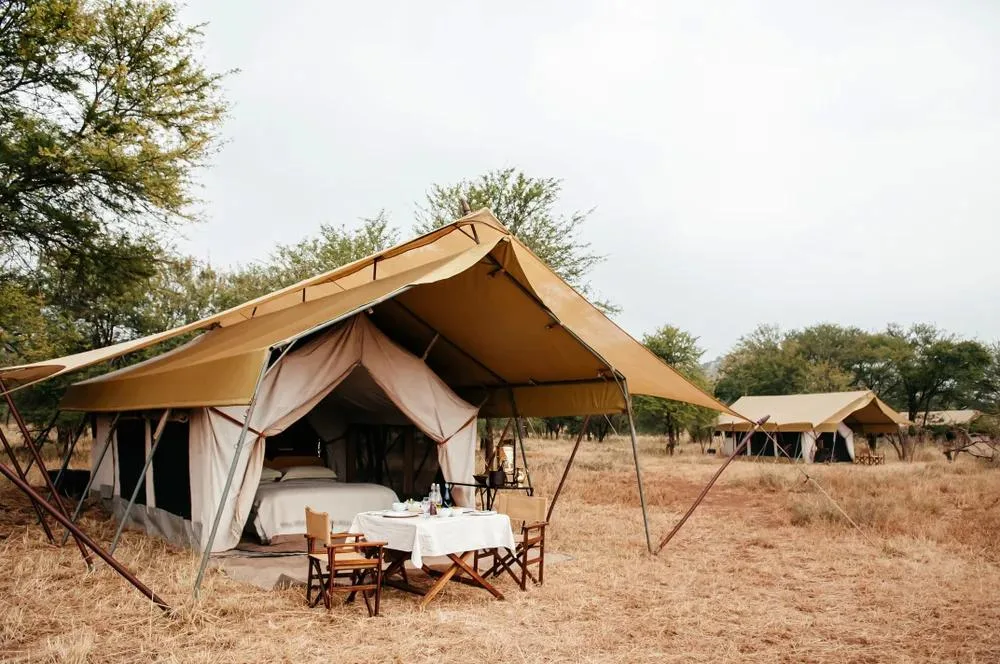
For many travellers the phrase tented camp conjures images of roughing it, but the reality is often closer to a boutique hotel under canvas. A modern safari tent is a spacious room with a proper bed, an ensuite bathroom and a veranda facing the bush, wrapped in walls of canvas rather than brick. Staying under canvas is the classic safari experience, placing you closer to the sounds and rhythms of the wild than any lodge can. You fall asleep to distant lions and wake to birdsong, with only a layer of fabric between you and the night. Knowing what to expect, from the layout of the tent to the routine of camp life and the safety rules after dark, helps you relax and enjoy this special way of travelling. This guide walks through a typical stay so nothing comes as a surprise.
Key things to know
- Tents are proper rooms with real beds, not what you pitch yourself
- Most have ensuite bathrooms with flush loos and hot showers
- Power is often solar and may be limited to certain hours
- Meals are social, high quality and follow the game-drive routine
- Nights are full of wild sounds, which is part of the magic
- After dark you are usually escorted to and from your tent
- Comfort ranges from simple mobile camps to lavish luxury tents
- Zip your tent closed and never keep food inside it
The tent itself
A safari tent is nothing like a backpacking dome. Expect a large canvas structure on a raised deck or solid floor, tall enough to stand in, with a comfortable bed, bedside tables, storage for clothes and often a writing desk and armchairs. The front usually opens onto a veranda overlooking a waterhole, river or plain.
Most permanent and semi-permanent camps have an ensuite bathroom at the rear, with a flushing toilet and a hot shower. In smaller mobile camps the shower may be a canvas bucket filled with hot water on request, and the toilet a neat short-drop, both private and surprisingly comfortable once you adjust.
- A raised deck or floor keeping you off the ground
- A real bed with linen, blankets and mosquito net
- Storage, lighting and often a veranda with chairs
- An ensuite or private bathroom just behind or beside the tent
Power, water and connectivity
Camps are often far off the grid, so power usually comes from solar panels and a generator that may run only at set times. Expect lights and a charging point in the tent, but plan for limited electricity: bring a power bank, and charge cameras during the day. Many camps have a central charging station in the main area.
Hot water for showers is often heated by a wood-fired boiler or solar, and may be plentiful at peak times and thinner late at night. Wi-Fi, if it exists, is usually slow and confined to the main lounge. Embracing the digital quiet is part of the appeal of a good camp.
Meals and the daily routine
Camp life follows the wildlife. You are woken before dawn for coffee and a light bite, then head out on the morning game drive when animals are most active. Brunch or a full breakfast follows on return, the middle of the day is for resting through the heat, and afternoon tea precedes the evening drive.
Meals are a highlight and usually far better than you expect. Breakfasts can be cooked to order, lunches are relaxed, and dinners are often communal, eaten by lantern or around a fire while guides and guests share the day's sightings. Dietary needs are easily catered for with a little notice.
- Pre-dawn wake-up with coffee before the morning drive
- Brunch or breakfast on return, then rest at midday
- Afternoon tea before the evening game drive
- Communal dinner by lamplight or around the fire
Nights under canvas
The nights are what people remember most. With only canvas between you and the bush, you hear everything: the whoop of hyenas, the sawing call of a leopard, the rumble of lions, and the astonishing volume of insects and frogs. It can feel intense at first, but it quickly becomes the soundtrack you travel for.
Animals often move through camp after dark, and you may wake to hippos grazing or an elephant browsing near your tent. This is normal and safe as long as you stay inside with the tent zipped shut. Keep a torch by the bed, and simply enjoy the sense of being a guest in a genuinely wild place.
Safety, escorts and etiquette
Unfenced camps rely on simple rules to keep everyone safe. After dark you are escorted to and from your tent by a guide or askari, so never walk around alone at night. During the day you can usually move freely in the central areas, but stay alert and follow the staff's guidance.
Inside the tent, keep it fully zipped when you are out or asleep, and never store food, which can attract animals and monkeys. Do not leave the veranda after dark, keep noise down, and if you need anything at night, use the horn, whistle or radio provided rather than stepping out. These small habits let you enjoy the wild in complete safety.
- Always be escorted to your tent after dark
- Keep the tent fully zipped when out or sleeping
- Never keep food or strong scents inside the tent
- Use the whistle or radio at night instead of walking out
References & further reading
- Sinclair, A. R. E., et al. (Eds.) (2015). Serengeti IV. Chicago: University of Chicago Press.
- Estes, R. D. (2012). The Behavior Guide to African Mammals. Berkeley: University of California Press.
- Kingdon, J. (2015). The Kingdon Field Guide to African Mammals (2nd ed.). London: Bloomsbury.
- IUCN (2024). The IUCN Red List of Threatened Species, Version 2024-1. www.iucnredlist.org.
Do it with SafariLingo
Take SafariLingo on safari: 300+ species, real animal calls, offline maps and sighting logs — all in your language, wherever you roam.
Get the appFrequently asked questions
Is a tented camp safe with animals around?
Yes, when you follow the simple rules. Camps are run by experienced staff, you are escorted after dark, and animals passing through are used to the tents. The key is to stay inside with the tent zipped at night, avoid keeping food in your tent, and never walk around alone in the dark.
Do tented camps have proper bathrooms?
Most permanent and semi-permanent camps have ensuite bathrooms with flushing toilets and hot showers. Smaller mobile or fly camps may use a bucket shower filled with hot water on request and a private short-drop toilet, which are simple but clean and comfortable.
Will I have electricity and Wi-Fi?
Usually some, but do not count on it being constant. Power is often solar or from a generator that runs at set hours, enough to charge cameras and phones. Wi-Fi, where available, tends to be slow and limited to the main area. Bring a power bank and enjoy the disconnection.
What should I pack for a tented camp?
Neutral, layered clothing for warm days and cold mornings, a good torch or headlamp, insect repellent, a power bank, and a light dust-proof bag for cameras. A warm layer for evening drives and around the fire is essential, as nights can be surprisingly cold.
Related guides
 Planning & Tips
 What to Look for in a Family-Friendly Safari Lodge
A practical guide to choosing a family-friendly safari lodge: minimum-age rules, family tents and interleading rooms, kids' programmes, private vehicles and guides, pools, flexible meals, safety and a sensible pace for children.
 Planning & Tips
 Eco-Lodges and Sustainable Safari Stays
How to recognise genuinely sustainable safari lodges: solar power, water and waste management, local employment, community revenue and low-impact building, and how to spot greenwashing behind the marketing.
 Planning & Tips
 Mobile Camping Safaris Explained
A clear guide to mobile camping safaris: how camps that move with the seasons and into wilderness work, the different comfort levels, the staff behind them, and why they offer exclusivity and value that fixed lodges rarely match.