
What to Look for in a Family-Friendly Safari Lodge
A practical guide to choosing a family-friendly safari lodge: minimum-age rules, family tents and interleading rooms, kids' programmes, private vehicles and guides, pools, flexible meals, safety and a sensible pace for children.
A safari can be the trip of a lifetime for a family, but the wrong lodge can turn it into a stressful ordeal for parents and a boring one for children. Not every camp is set up for young travellers: some have strict minimum ages, unfenced boundaries, rigid meal times and long game drives that test the patience of any child. Choosing well is the single biggest factor in whether your family safari is joyful or exhausting. The good news is that a growing number of lodges actively welcome families and build their whole experience around them. They offer family units, dedicated children's guides, shorter and more varied activities, and the flexibility to eat and rest when your children need to. The trick is knowing which features genuinely matter and which are just marketing. This guide walks through the things that make or break a family safari lodge, from age policies and room layouts to kids' programmes, private vehicles, safety and pacing, so you can book with confidence and give everyone, adults and children alike, a holiday they will remember for the right reasons.
Key things to know
- Minimum-age rules vary hugely between lodges and often differ for shared versus private activities.
- Family tents, interleading rooms or private houses matter more than almost any other single feature.
- A dedicated kids' programme with a specialist guide keeps children engaged and adults relaxed.
- A private vehicle and guide let you set your own pace and leave a drive early without guilt.
- A pool and shaded downtime are essential for the long, hot middle of the day.
- Flexible meal times and child-friendly food prevent hungry, cranky meltdowns.
- Ask detailed safety questions about fencing, plunge pools, walkways and night escorts.
- Match the pace and activity length to your children's ages rather than a standard itinerary.
Minimum-age rules and why they exist
The first question to ask any lodge is its minimum-age policy, because it can quietly rule out a property before you go any further. Many high-end camps set a minimum age of six, eight or even twelve for shared game drives, both for the children's safety and out of consideration for other guests who have paid a premium for quiet sightings. Some camps allow younger children only if you book a private vehicle and guide, which changes the cost equation significantly.
These rules are not arbitrary. Young children can find long, quiet drives difficult, and a sudden noise near a skittish animal can end a sighting for everyone. Unfenced camps in big-game areas carry real risks that some operators are simply unwilling to take with toddlers. Always confirm the age policy in writing, and ask specifically whether it differs for private activities, family units or in-camp time versus game drives.
- Many camps set minimum ages of six, eight or twelve
- Rules often relax if you book a private vehicle and guide
- Policies protect both children and other paying guests
- Unfenced big-game camps may exclude very young children
- Always confirm the exact policy in writing before booking
Room layouts that actually work for families
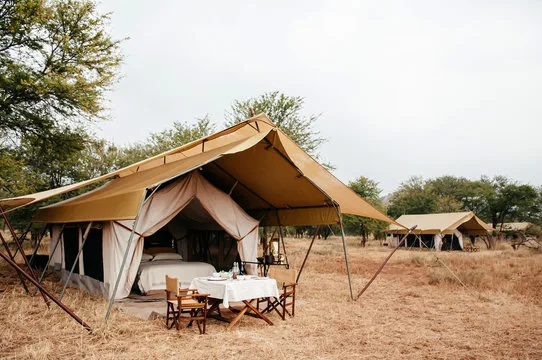
Where your family sleeps shapes the whole trip. A single room with one extra bed squeezed in works for a night but becomes miserable over a week, so look for family tents, interleading or adjoining rooms, or a private house or villa. Interleading rooms let parents and children have their own space while staying connected by an internal door, which is reassuring for younger kids and civilised for teenagers and adults alike.
Private houses and multi-room villas, increasingly common at family-focused lodges, are often the best solution of all. They give you a private guide and vehicle, a dedicated host or chef, and the freedom to run your own timetable without disturbing other guests. For multi-generational trips with grandparents, this kind of exclusive-use space can be far better value and far less stressful than several separate rooms.
- Avoid cramming a family into one room for a whole trip
- Interleading rooms balance connection with privacy
- Family tents are purpose-built for parents and children
- Private houses often include a dedicated guide and host
- Exclusive-use villas suit multi-generational groups well
Kids' programmes and specialist guides
The best family lodges do far more than tolerate children; they build activities around them. A good kids' programme might include junior ranger courses, tracking and spooring lessons, bug hunts, cast-making of animal prints, baking with the camp chef, star talks and cultural visits to nearby communities. These break up the day, teach real bush skills and let children burn energy safely inside the camp.
Just as important is a specialist children's guide who knows how to pitch the bush to a young audience, keeping things fun, safe and age-appropriate. This frees parents to enjoy a longer drive or simply relax, knowing the children are engaged and supervised. When you enquire, ask what is actually included versus what costs extra, whether programmes run daily, and how they adapt to different ages within one family.
- Junior ranger and tracking courses teach real bush skills
- Bug hunts, baking and star talks fill in-camp downtime
- A specialist children's guide keeps activities age-appropriate
- Kids' programmes free parents for longer drives or rest
- Confirm what is included, how often and for which ages
Private vehicles, guides and pacing
A private vehicle and guide is arguably the most valuable upgrade for a family. It lets you set your own pace, stop for a toilet break or a snack without apology, cut a drive short when a toddler flags, or linger longer when the children are entranced. On a shared vehicle, a restless child can strain relations with other guests, and you are locked into the group's schedule and interests.
Pacing is everything with children. Rather than two long game drives a day, families often do better with one shorter morning drive, a relaxed midday break and a gentle late-afternoon activity. Look for lodges that offer varied, shorter outings, walking where age allows, boat trips, and time simply to enjoy the pool and the camp. A well-paced safari keeps children curious rather than exhausted, which is better for everyone.
- A private vehicle lets you set your own schedule and stops
- You can cut a drive short or linger without disturbing others
- Shorter, varied outings suit children better than long drives
- Balance one drive with downtime and gentle activities
- Good pacing keeps children curious rather than overtired
Pools, downtime and child-friendly food
The middle of a safari day is long and hot, and children need somewhere to unwind. A pool is close to essential for families, giving kids a way to cool off and let off steam while adults rest. Shaded play areas, a library of games and safe space to roam within a fenced camp all make the non-drive hours far easier. Without these, the gap between drives can feel endless for a restless child.
Food matters more than parents expect. Rigid, late dinners and adventurous set menus do not suit young children, so look for lodges offering flexible meal times, early kids' suppers and familiar, simple options alongside the gourmet fare. The ability to feed children early and get them to bed, then enjoy a peaceful adult dinner, transforms the rhythm of a family safari and keeps everyone happier.
- A pool is close to essential for the hot midday hours
- Shaded play areas and games ease the gap between drives
- Flexible meal times prevent hungry, cranky children
- Early kids' suppers let adults enjoy a peaceful dinner
- Simple, familiar food options reassure fussier eaters
Safety questions every family should ask
Safety underpins everything on a family safari, and you should never feel shy about asking detailed questions. In unfenced camps, animals can and do wander through, so ask how children are kept safe: are there escorts to and from tents after dark, is there a fenced core area, and what are the rules about children being alone. Plunge pools and raised walkways are common features that need clear supervision rules for younger kids.
Go further and ask about medical preparedness: how far is the nearest clinic or hospital, is there evacuation cover, and does the camp carry first-aid supplies and staff trained to use them. Confirm malaria status and whether the region is a lower-risk choice for young families. A reputable lodge will answer all of this clearly and without defensiveness; hesitation or vague answers are a red flag worth heeding.
- Ask about night escorts and fenced core areas in camp
- Clarify supervision rules for plunge pools and walkways
- Check distance to medical care and evacuation cover
- Confirm the camp carries first aid and trained staff
- Consider lower-malaria regions for young families
References & further reading
- Sinclair, A. R. E., et al. (Eds.) (2015). Serengeti IV. Chicago: University of Chicago Press.
- Estes, R. D. (2012). The Behavior Guide to African Mammals. Berkeley: University of California Press.
- Kingdon, J. (2015). The Kingdon Field Guide to African Mammals (2nd ed.). London: Bloomsbury.
- IUCN (2024). The IUCN Red List of Threatened Species, Version 2024-1. www.iucnredlist.org.
Do it with SafariLingo
Take SafariLingo on safari: 300+ species, real animal calls, offline maps and sighting logs — all in your language, wherever you roam.
Get the appFrequently asked questions
What is the best age to take children on safari?
There is no single answer, but many families find that children of around six and older get the most from a safari, as they can sit through drives, follow a guide and remember the experience. Younger children can absolutely enjoy it too, especially at family-focused lodges with a private vehicle, shorter activities and a good kids' programme. The right lodge matters far more than a specific age.
Do we really need a private vehicle for a family safari?
It is not essential, but it is the single most useful upgrade for families with younger children. A private vehicle lets you set your own pace, stop when needed and end a drive early without affecting other guests. If a private vehicle is beyond budget, look for lodges with short, family-friendly shared drives and generous in-camp activities instead.
Is malaria a reason to avoid safaris with young children?
It is a serious consideration, but not an automatic no. Several excellent safari regions are malaria-free or low-risk, making them popular with young families. If you choose a malaria area, consult a travel doctor well in advance about suitable prophylaxis for children and rigorous bite prevention. Many families simply prioritise malaria-free reserves while their children are very young.
How long should a family safari be?
For younger children, three to four nights at one well-chosen lodge is often ideal, avoiding tiring transfers and letting them settle into a rhythm. Older children and teenagers can manage longer trips and multiple camps. Building in a relaxed beach or town stay before or after the safari can also help break up travel and give everyone a change of pace.
Will children get bored between game drives?
Not at a well-chosen family lodge. The best properties fill the midday downtime with kids' programmes, pools, games and safe space to play, so children stay engaged rather than restless. If you book a lodge with no facilities for children and only long drives, boredom is far more likely, which is exactly why matching the lodge to your family matters so much.
Related guides
 Planning & Tips
 Eco-Lodges and Sustainable Safari Stays
How to recognise genuinely sustainable safari lodges: solar power, water and waste management, local employment, community revenue and low-impact building, and how to spot greenwashing behind the marketing.
 Planning & Tips
 Mobile Camping Safaris Explained
A clear guide to mobile camping safaris: how camps that move with the seasons and into wilderness work, the different comfort levels, the staff behind them, and why they offer exclusivity and value that fixed lodges rarely match.
 Planning & Tips
 Fly Camping and Sleeping Out Under the Stars
What fly camping is, how a night sleeping out in the bush works, the equipment and safety, what to expect from bedrolls to bucket showers, and who this adventurous experience suits.