
Wildebeest and the Logic of the Herd
Why wildebeest gather in their millions — the ecology behind the mega-herds, synchronised calving, predator swamping, grazing succession with zebra, and the behaviour to watch long before any river crossing.
The wildebeest is the unglamorous engine of Africa's greatest wildlife spectacle. It has none of the leopard's elegance or the elephant's gravitas, and first-time visitors often dismiss it as a shabby, awkward antelope with a horse's mane and a beard. Yet without the wildebeest there would be no Great Migration, no annual pulse of nearly a million and a half animals turning the Serengeti–Mara ecosystem into the richest predator theatre on Earth. To understand the migration you have to understand the herd as a strategy rather than a crowd. Everything the wildebeest does — where it walks, when it gives birth, how it grazes, why it panics — is shaped by two relentless pressures: finding nutritious grass and not being eaten. The herd is the wildebeest's answer to both, and it is a startlingly effective one. This guide looks past the famous river crossings to the biology that makes them possible: the mega-herd and safety in numbers, the extraordinary synchronised calving on the southern plains, the grazing partnership with zebra and gazelle, and the rhythm of rainfall that drives the whole clockwise circuit. Learn to read the herd and even a quiet plain full of grazing wildebeest becomes fascinating.
Key things to know
- The migratory wildebeest of the Serengeti–Mara are white-bearded wildebeest, numbering well over a million.
- The herd is a survival strategy: many eyes, confusion of numbers, and safety through sheer abundance.
- Around 400,000 to 500,000 calves are born within a few weeks on the southern short-grass plains, swamping predators.
- Wildebeest calves can stand and run within minutes of birth — essential for a life on the open plains.
- Zebra, wildebeest and gazelle graze in succession, each preparing the sward for the next.
- Migration follows the rains and the flush of mineral-rich short grass, not a fixed calendar date.
- Beyond crossings, watch for rutting males, marching columns, and the constant low grunting of the herd.
- The dramatic river crossings are a small, dangerous fraction of a year-round journey.
Who is the wildebeest, really?
The animal at the centre of the migration is the white-bearded wildebeest, a subspecies of the blue wildebeest, built for endurance grazing on open grassland. It is a bulk feeder that thrives on short, green, growing grass and must drink regularly, which ties its movements tightly to rainfall and fresh pasture. Ungainly as it looks, it is superbly adapted: broad muzzle for cropping lawns of grass, strong homing and following instincts, and a physiology that lets it walk enormous distances year after year.
Wildebeest are intensely gregarious, and that is the key to everything. A lone wildebeest is a nervous, vulnerable animal; a wildebeest in a herd of ten thousand is part of a living system with hundreds of ears and eyes. This sociability is not sentiment but arithmetic. The larger the aggregation, the lower any individual's personal odds of being the one a lion or hyena selects — and the migration is the largest aggregation of large mammals left on the planet.
The logic of the mega-herd
The mega-herd works through a handful of simple, powerful principles. Sheer numbers dilute individual risk: a predator can only kill so many, so being one animal among tens of thousands is statistically safe. Countless eyes and ears mean threats are detected early, and a running herd creates a bewildering wall of movement that makes it hard for a hunter to lock onto a single target. Panic itself is contagious and functional, rippling through the herd faster than any one animal could react alone.
There are costs, of course. Big herds strip grazing quickly and must keep moving, they foul water, and disease can spread. But the balance falls firmly in favour of the crowd, which is why wildebeest tolerate the crush and dust and noise of living shoulder to shoulder. For the traveller, understanding this turns a 'boring' plain of grazers into a masterclass in evolutionary strategy playing out in real time.
- Dilution: individual odds of being caught fall as herd size rises.
- Detection: thousands of eyes and ears spot predators early.
- Confusion: a moving mass makes it hard to single out one target.
- Contagious alarm: panic spreads faster than any lone response.
- Trade-offs: fouled water, stripped grazing and disease risk.
Synchronised calving: the great birth pulse
The most astonishing chapter of the wildebeest year happens not at a river but on the short-grass plains of the southern Serengeti and the Ndutu area, roughly from late January into February and March. Here, within a window of just a few weeks, something like 400,000 to 500,000 calves are born. This tight synchrony is a deliberate strategy called predator swamping: by producing far more calves at once than the local lions, hyenas, cheetahs and jackals can possibly eat, the herd guarantees that most survive simply by overwhelming demand.
A newborn wildebeest is up on its feet in minutes and can run with the herd within the hour — one of the fastest starts to life of any mammal, and non-negotiable on plains where lying still means being eaten. The calving grounds are chosen for their mineral-rich volcanic soils, which grow the calcium- and phosphorus-heavy grasses that lactating mothers need. Watching thousands of gangly calves testing their legs against a backdrop of circling predators is one of the most moving sights in African wildlife.
- Peak calving falls roughly across February on the southern plains.
- Around 400,000 to 500,000 calves arrive in a few short weeks.
- Synchrony swamps predators so most calves survive.
- Calves stand within minutes and run within the hour.
- Mineral-rich volcanic soils grow the grass nursing mothers need.
Grazing succession: the herd is not alone
The wildebeest does not migrate alone; it travels in loose partnership with plains zebra and Thomson's gazelle, and the three species divide the grassland between them in a neat ecological sequence known as grazing succession. Zebra, with their tough digestive systems, move through first and eat the tall, coarse, fibrous tops of the grass. This exposes the shorter, greener, more nutritious growth that wildebeest prefer, and their heavy grazing in turn stimulates the very short, tender shoots that the small, selective Thomson's gazelle seek out.
Far from competing destructively, the three species effectively farm the plains for one another, each preparing the sward for the next. This is why you so often see mixed columns of zebra and wildebeest moving together and grazing the same ground in sequence. It also spreads the risk: more species means more alarm calls and more confusion for predators. Recognising this partnership is one of the quiet pleasures of a knowledgeable safari.
- Zebra graze first, removing tall, coarse grass.
- Wildebeest follow, cropping the medium, greener sward.
- Thomson's gazelle take the shortest, most tender regrowth.
- Mixed herds share alarm calls and predator confusion.
- The sequence keeps grassland productive rather than exhausted.
Why they migrate: following the rain
The migration is not a fixed date on a calendar but a response to rainfall and grass. Broadly, the herds spend the wet months on the mineral-rich southern short-grass plains, where calving happens; as those plains dry out they move north and west through the central and western Serengeti; by the middle of the dry season many push into Kenya's Masai Mara, where the crossings of the Mara and Grumeti rivers occur; and as the short rains return they swing south again to begin the cycle anew. The whole loop is roughly clockwise and covers hundreds of kilometres.
What pulls them is the flush of new grass that follows rain — young, protein- and mineral-rich growth that is far more nutritious than old, dry stems. Because rainfall varies from year to year, so does the timing and route; no two migrations are identical, and any operator who promises you a guaranteed crossing on a fixed date is overselling. The honest guidance is to travel to the right region for the season and give yourself enough days for the herds and the rain to cooperate.
Behaviour to watch beyond the crossings
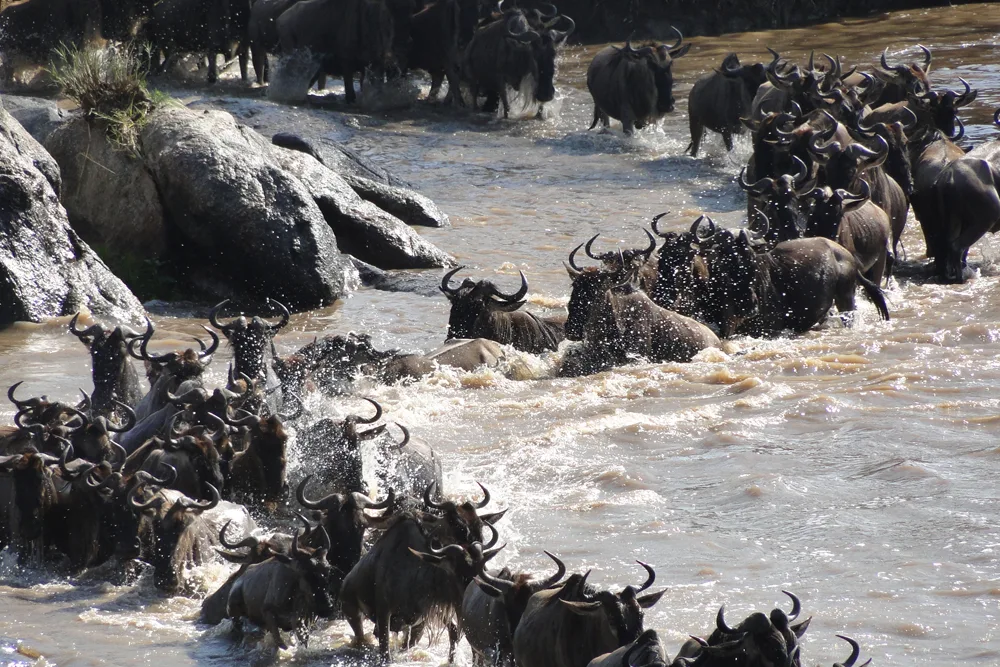
Because river crossings are so dramatic they dominate the imagination, but they are a tiny, dangerous fraction of the wildebeest's year. Slow down and the everyday behaviour is just as rewarding. During the rut, which peaks around the middle of the year, territorial bulls carve out small patches, cavort, snort and clash horns, filling the air with a rolling chorus of nasal grunting that carries for kilometres. Watching a bull herd females across his patch while fending off rivals is pure theatre.
On the move, wildebeest form the long, single-file columns that give the migration its iconic look, threading across the plains in lines that can stretch to the horizon. Watch how the herd responds to threat: heads up in unison, a ripple of alertness, then either a settling back to grazing or an explosive stampede. Learn the constant low grunting — the sound of the migration — and you will often hear the herds before you see them. These quieter behaviours, not just the crossings, are the real story of the herd.
- Rutting bulls establish small territories and clash around mid-year.
- The nasal grunting chorus can be heard long before the herd appears.
- Marching columns form the migration's iconic single-file lines.
- Watch synchronised head-ups and ripples of alarm across the herd.
- Everyday grazing and movement reveal far more than crossings alone.
References & further reading
- Sinclair, A. R. E., et al. (Eds.) (2015). Serengeti IV. Chicago: University of Chicago Press.
- Estes, R. D. (2012). The Behavior Guide to African Mammals. Berkeley: University of California Press.
- Kingdon, J. (2015). The Kingdon Field Guide to African Mammals (2nd ed.). London: Bloomsbury.
- IUCN (2024). The IUCN Red List of Threatened Species, Version 2024-1. www.iucnredlist.org.
Do it with SafariLingo
Take SafariLingo on safari: 300+ species, real animal calls, offline maps and sighting logs — all in your language, wherever you roam.
Get the appFrequently asked questions
How many wildebeest are in the Great Migration?
The migratory population of white-bearded wildebeest in the Serengeti–Mara ecosystem is well over a million, often cited at around 1.3 to 1.5 million, travelling alongside several hundred thousand zebra and gazelle. Numbers fluctuate year to year with rainfall and calf survival.
When and where is the wildebeest calving?
Peak calving happens roughly across February on the short-grass plains of the southern Serengeti and the Ndutu area. Hundreds of thousands of calves are born within a few weeks, which makes it one of the best times for predator action. Exact timing shifts with the rains.
Why do wildebeest and zebra travel together?
They graze in succession rather than competing: zebra eat the tall coarse grass, wildebeest crop the medium growth, and gazelle take the shortest shoots. Travelling together also multiplies eyes and ears against predators, so the partnership benefits all three species.
Can I plan a trip to guarantee seeing a river crossing?
No honest operator can guarantee a crossing on a set date, because the herds follow the rains and cross when they choose. You improve your odds enormously by being in the Mara or northern Serengeti in the right months and staying several days, but flexibility and patience are essential.
Are wildebeest dangerous or aggressive?
To people in a vehicle they are essentially harmless and skittish; they will flee rather than confront. Rutting bulls spar with each other but pose no real threat to observers. The danger on the plains is to the wildebeest themselves, from lions, hyenas, crocodiles and the rivers.
Related guides
 Wildlife
 Baboons and Monkeys: Behaviour to Watch
A field guide to Africa's primates on safari — baboon troop hierarchy, vervet and colobus monkeys, feeding, grooming, alarm calls, and how to behave around camp-raiders.
 Wildlife
 Spotting African Wild Dogs, Africa's Rarest Large Predator
How to find the painted wolf: pack biology, extraordinary hunting success, denning, vast ranges, why they are endangered, and the reserves that give you the best chance.
 Wildlife
 Understanding Hyena Clans
A guide to Africa's misunderstood hyenas — spotted, brown and striped species, matriarchal clan society, hunting versus scavenging, den life and where to watch them.