
Red-headed Rock Agama
Agama lionotus
Quick facts
Red-headed Rock Agama (Agama lionotus) is a Reptiles you may encounter across Eastern Africa, especially Kenya, Tanzania, and Uganda, wherever rocky habitat occurs. It prefers Rocky outcrops, boulders, cliffs, walls, and buildings in savanna and dry country, feeds mainly on Mainly insects, especially ants, beetles, and grasshoppers, with some plant matter, and is most active Diurnal and heliothermic; basks and does 'push-up' displays on rocks, retreating into crevices when threatened. On the IUCN Red List it is listed as Least Concern.
| Scientific name | Agama lionotus |
|---|---|
| Conservation status | Least Concern |
| Sighting difficulty | Moderate |
| Best season | Dry season (Jun–Oct) |
| Class | Reptilia |
| Order | Squamata |
| Family | Agamidae |
| Size | Total length about 25-35 cm including the tail |
How to identify
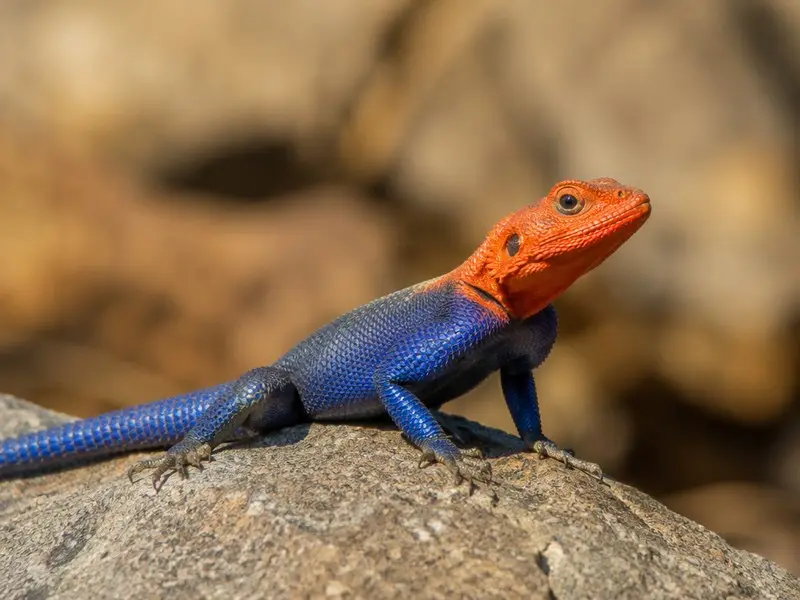
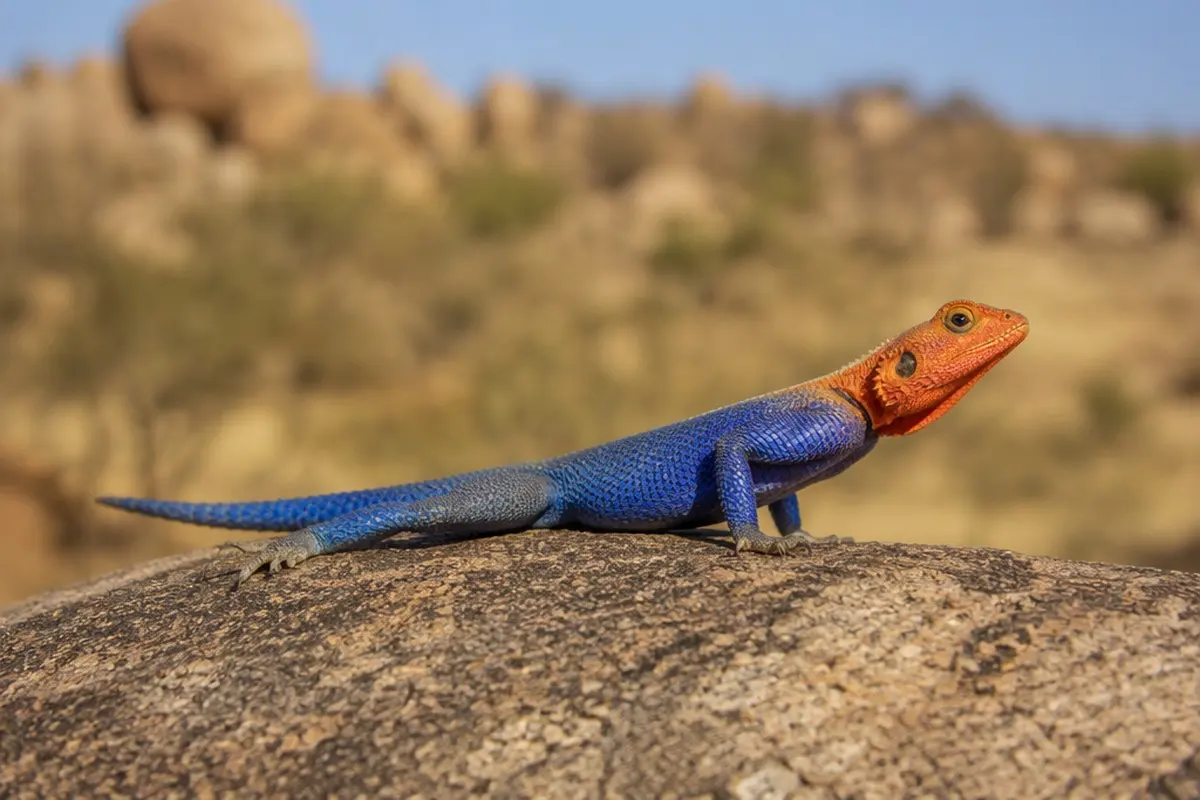
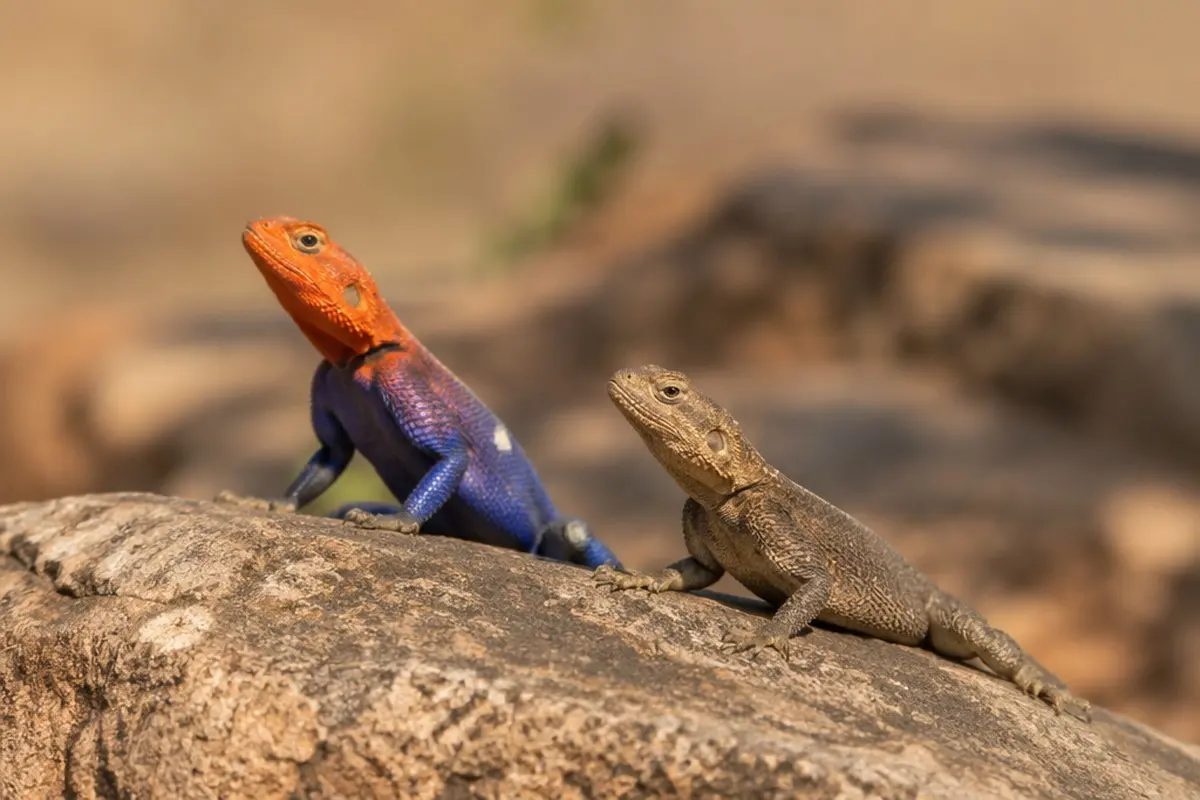
Dominant males are brilliant, with an orange-red head and neck and a deep blue body and tail; females and non-display males are dull brown for camouflage.
Habitat
Rocky outcrops, boulders, cliffs, walls, and buildings in savanna and dry country
Diet
Mainly insects, especially ants, beetles, and grasshoppers, with some plant matter
When it is active
Diurnal and heliothermic; basks and does 'push-up' displays on rocks, retreating into crevices when threatened
Where it lives
Eastern Africa, especially Kenya, Tanzania, and Uganda, wherever rocky habitat occurs
How to spot it
Look on sunlit rocks, lodge walls, and kopjes across East African parks in the heat of the day, when males display prominently
Photography tips
Shoot in bright daylight to saturate the orange and blue; a low angle on a plain rock isolates the vivid male beautifully
Threats
No significant threats; abundant and adaptable, often thriving around lodges and human structures
Similar species
Other agamas overlap, but breeding males of this species are unmistakable with their orange-red head and blue body.
Field guide notes
How to Spot the Red-headed Rock Agama on an African Safari
The Red-headed Rock Agama is one of the most sought-after species to track on an African safari, and knowing its habits turns a hopeful search into a confident one. This field guide breaks down how to recognise the Red-headed Rock Agama at a glance, the habitats and times of day that reward patient searching, and the practical tracking craft guides rely on. Read it before you set out and you will spend less time scanning empty bush and more time watching the animal itself.
Dominant males are brilliant, with an orange-red head and neck and a deep blue body and tail; females and non-display males are dull brown for camouflage.
Concentrate your search for the Red-headed Rock Agama in Rocky outcrops, boulders, cliffs, walls, and buildings in savanna and dry country, the habitat where it feels most secure and finds its food. It is most active Diurnal and heliothermic; basks and does 'push-up' displays on rocks, retreating into crevices when threatened, so plan your game drives around those hours rather than the heat of midday. Across the continent the species ranges through Eastern Africa, especially Kenya, Tanzania, and Uganda, wherever rocky habitat occurs, and within that range the richest sightings come where prime habitat meets low human disturbance.
Finding the Red-headed Rock Agama starts long before you see it. Learn the habitat it depends on — Rocky outcrops, boulders, cliffs, walls, and buildings in savanna and dry country — and you narrow the search from an entire landscape to a handful of promising corners. Animals are not scattered at random; they sit where food, water, cover and safety overlap, and the Red-headed Rock Agama is no exception.
Red-headed Rock Agama: Facts, Habitat and Conservation
The Red-headed Rock Agama (Agama lionotus) is a distinctive part of Africa's living landscape, and understanding it adds depth to every sighting. This guide gathers the facts that matter most to travellers — where it lives, what it eats, how to tell it apart from similar species, and how it is coping in a changing world. Think of it as the background a good guide would share before you meet the animal in the field.
The Red-headed Rock Agama is typically found in Rocky outcrops, boulders, cliffs, walls, and buildings in savanna and dry country, where the vegetation, water and cover match its needs through the seasons. Its diet is built around Mainly insects, especially ants, beetles, and grasshoppers, with some plant matter, and those food sources shape where it spends its time and how far it must travel each day. Watching what and where an animal feeds is often the quickest way to predict where you will find it next.
The Red-headed Rock Agama is most active Diurnal and heliothermic; basks and does 'push-up' displays on rocks, retreating into crevices when threatened, a rhythm tied to temperature, predators and the habits of its prey or grazing. In the field you can pick it out by these features: Dominant males are brilliant, with an orange-red head and neck and a deep blue body and tail; females and non-display males are dull brown for camouflage.. Learning one or two reliable field marks lets you name it with confidence even at a distance or in poor light.
On the IUCN Red List the Red-headed Rock Agama is currently assessed as Least Concern, a status that reflects both its numbers and the pressures on its range. The main threats it faces are No significant threats; abundant and adaptable, often thriving around lodges and human structures, and these rarely act alone — habitat loss, human conflict and climate shifts tend to compound one another. Choosing responsible operators and well-managed reserves is one practical way visitors help fund its protection.
FAQ
Where is the best place to see a Red-headed Rock Agama?
The Red-headed Rock Agama ranges across Eastern Africa, especially Kenya, Tanzania, and Uganda, wherever rocky habitat occurs, but distribution alone is only half the story. Your best odds come inside well-managed protected areas within that range where its preferred habitat — Rocky outcrops, boulders, cliffs, walls, and buildings in savanna and dry country — is extensive and healthy. Reserves with low vehicle traffic and experienced guiding teams consistently deliver the closest, calmest sightings.
Is the Red-headed Rock Agama easy to see on safari?
That depends on how secretive the species is and how well you time your search. Because the Red-headed Rock Agama is most active Diurnal and heliothermic; basks and does 'push-up' displays on rocks, retreating into crevices when threatened, aligning your game drives with those hours dramatically improves your chances. Travelling with a guide who knows the local individuals and their movements matters more than luck.
What should I take to help me find the Red-headed Rock Agama?
A decent pair of binoculars is the single most useful tool, ideally 8x42 or 10x42 for a bright, steady image. A field guide or the SafariLingo app helps you confirm the identification and rule out look-alike species. Neutral clothing, patience and a willingness to sit quietly do the rest.
You might also like
 LC
LC Black Mamba
Dendroaspis polylepis
 LC
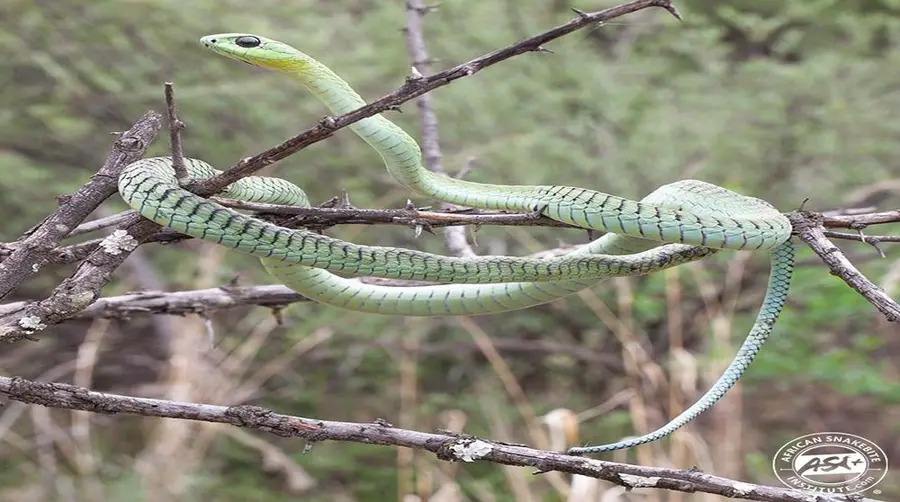
LC Boomslang
Dispholidus typus
 LC
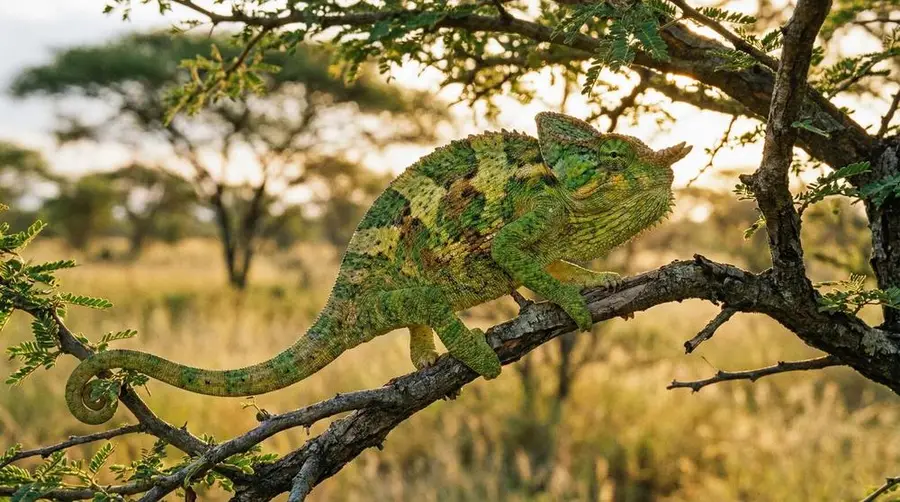
LC Flapneck Chameleon
Chamaeleo dilepis
 LC
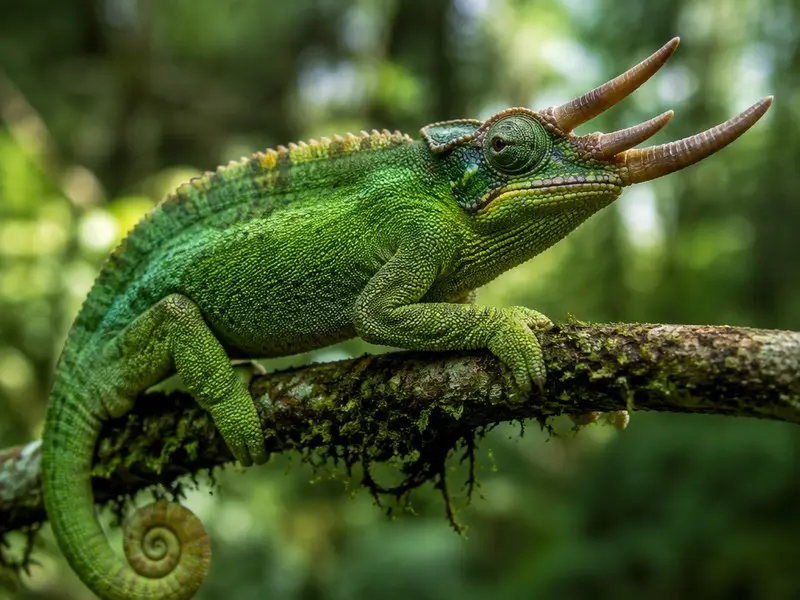
LC Jackson's Chameleon
Trioceros jacksonii
 LC
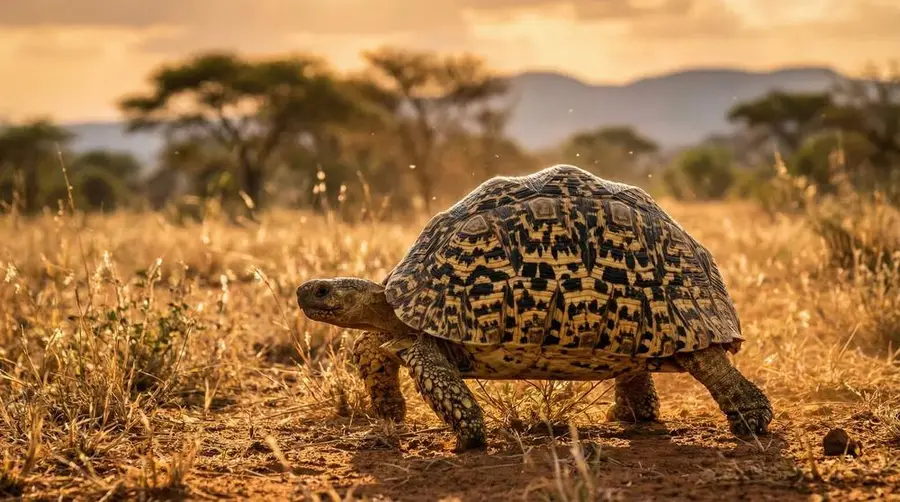
LC Leopard Tortoise
Stigmochelys pardalis
 LC
LC Mozambique Spitting Cobra
Naja mossambica
 LC
LC Nile Crocodile
Crocodylus niloticus
 LC
LC Nile Monitor
Varanus niloticus